📖 Study Guide
Learn Japanese through stories.
These stories include Japanese culture,
daily life, travel experiences,
and conversations between people.
1. Read the English text.
2. Read the Japanese text.
3. Use Romaji if needed.
4. Review the vocabulary.
🌸 Story
Sakura and Sumire are getting ready
to go home in their classroom.
さくらとすみれが、
教室で帰り支度をしている。
Sakura to Sumire ga,
kyoushitsu de kaerijitaku o shite iru.

Guess what?
Winter starts tomorrow! 😳
明日って、
もう冬なんだって!😳
Ashita tte,
mou fuyu nan datte! 😳

What do you mean?
どういうこと?
Dou iu koto?
“Rittō.”
「立冬」って書いてあったの。
“Rittou” tte kaite atta no.
On the traditional calendar,
it marks the start of winter.
暦の上では、
冬の始まりなんだよね。
Koyomi no ue de wa,
fuyu no hajimari nan da yo ne.
Isn’t it still autumn? 🤔
まだ秋じゃない?🤔
Mada aki ja nai? 🤔
We can still enjoy
the autumn leaves, too.
紅葉だって、
まだ楽しめるものね。
Kouyou datte,
mada tanoshimeru mono ne.
Just yesterday,
we were talking about the long autumn nights.
And now they’re saying it’s winter already! 😅
昨日なんて、
秋の夜長の話をしてたのに。
もう冬です!って言われてもねー。😅
Kinou nante,
aki no yonaga no hanashi o shiteta noni.
Mou fuyu desu! tte iwarete mo nee. 😅
The seasons don’t change
all at once, you know.
季節って、
急に切り替わるものじゃないからね。
Kisetsu tte,
kyuu ni kirikawaru mono ja nai kara ne.
I wonder who decided
when Rittō should be. 🤔
立冬って、
誰が決めたんだろう?🤔
Rittou tte,
dare ga kimeta n darou? 🤔

24 traditional seasonal markers, meow.
They’re based on the sun’s movement
and divide the year into 24 parts, meow.
So just because it’s Rittō,
it doesn’t suddenly get cold, meow. 🐾
二十四節気のひとつだにゃー。
太陽の動きをもとに、
一年を24に分けた季節の目印なんだにゃー。
だから、立冬になったからといって、
急に寒くなるわけじゃないにゃー。🐾
nijuu-shisekki no hitotsu da nyaa.
Taiyou no ugoki o moto ni,
ichinen o nijuu-yon ni waketa kisetsu no mejirushi nan da nyaa.
Dakara, rittou ni natta kara to itte,
kyuu ni samuku naru wake ja nai nyaa. 🐾
So I can still
enjoy autumn, right? 😊
じゃあ、まだ秋を
楽しんでいてもいいんだね!😊
Jaa, mada aki o
tanoshinde ite mo ii n da ne! 😊
I still want to eat roasted sweet potatoes
and see the autumn leaves! 🍠🍁
まだ焼き芋も食べたいし、
紅葉も見たいし!🍠🍁
Mada yakiimo mo tabetai shi,
kouyou mo mitai shi! 🍠🍁
Looks like autumn
isn’t over for you yet, Sakura! 🤣
さくらの秋は、
まだまだ終わらなさそうだね!🤣
Sakura no aki wa,
mada mada owaranasasou da ne! 🤣
turns into winter, meow. 🐾
ゆっくり変わっていくんだにゃー。🐾
yukkuri kawatte iku n da nyaa. 🐾
💭 Story Note
### 🍁 Rittō — The Beginning of Winter
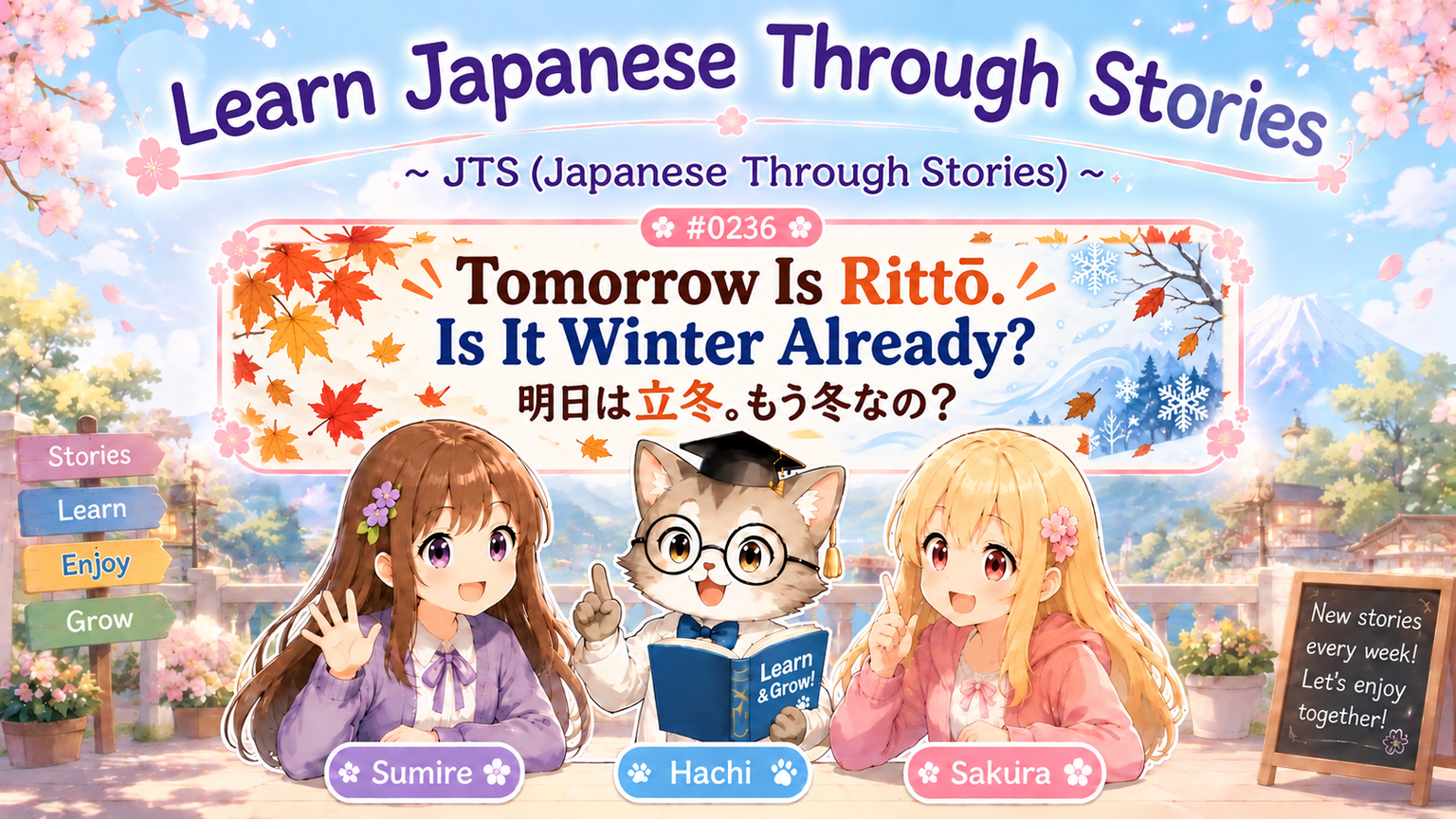
In Japan, November 7, 2026, is **Rittō (立冬)**, the traditional beginning of winter.
But Rittō doesn’t mean the weather suddenly becomes cold.
You might still see colorful autumn leaves, enjoy warm afternoons, or eat roasted sweet potatoes.
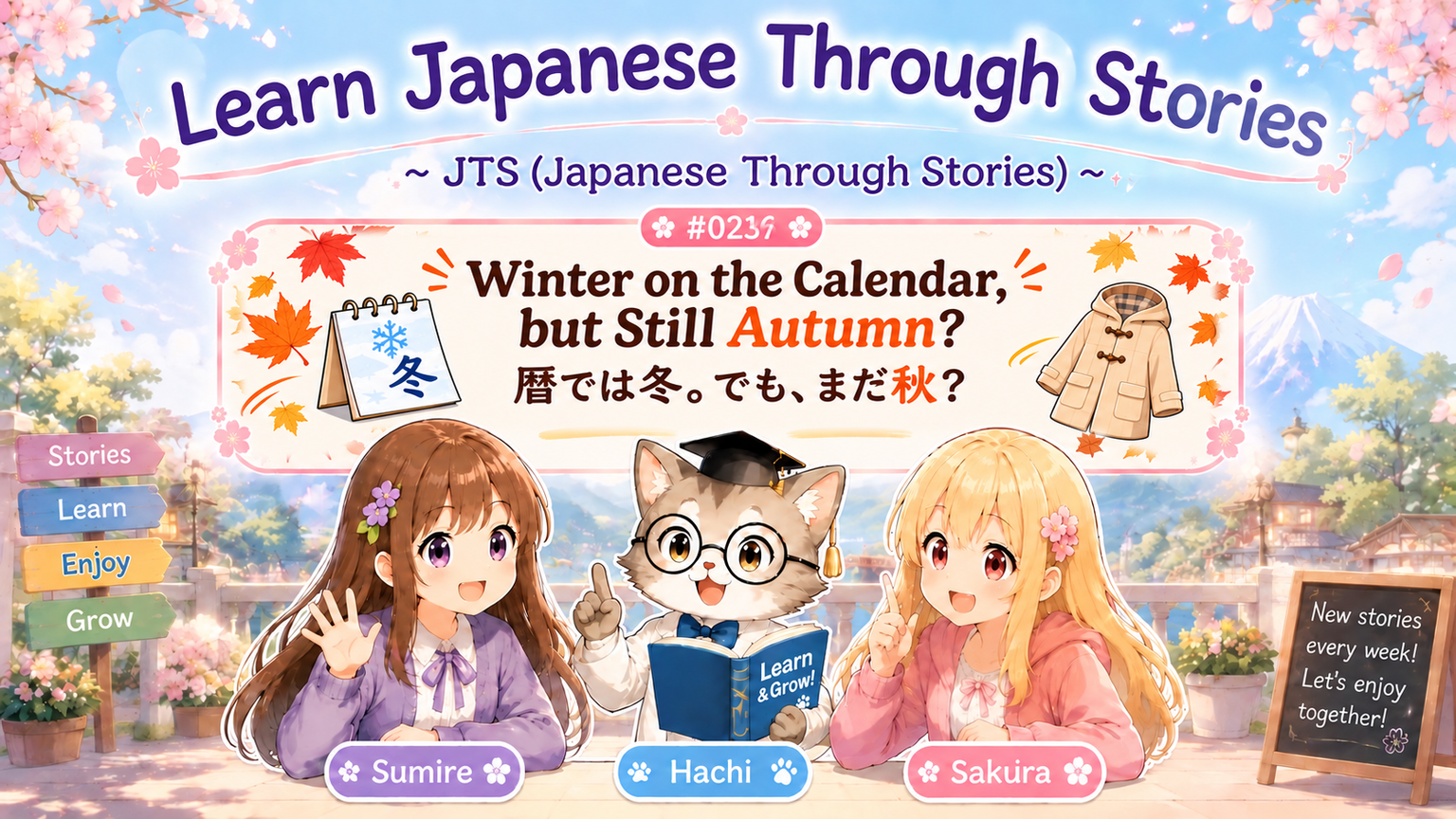
That’s why Sakura is surprised when she sees “Rittō” on the calendar.
To her, it still feels like autumn!
### ☀️ The 24 Seasonal Markers
Rittō is one of the **24 traditional seasonal markers**, called *nijūshi sekki* (二十四節気).
These markers divide the year into 24 parts based on the sun’s position.
They have been used in Japan to describe seasonal changes and help people recognize the rhythm of the year.
Some familiar examples are:
– **Risshun (立春)** — Beginning of Spring
– **Rikka (立夏)** — Beginning of Summer
– **Risshū (立秋)** — Beginning of Autumn
– **Rittō (立冬)** — Beginning of Winter
These names tell us when a season begins on the traditional calendar, even when the weather still feels like the previous season.
### 🍠 Enjoying Autumn a Little Longer
For Sakura, the beginning of winter doesn’t mean she has to stop enjoying autumn.
There are still autumn leaves to see and roasted sweet potatoes to eat!
In Japan, *yakiimo* (焼き芋), or roasted sweet potatoes, are a familiar autumn and winter treat.
They are often enjoyed warm, especially when the weather becomes cooler.
Seasons don’t change overnight.
Sometimes, autumn and winter seem to overlap for a little while.
And that is part of the beauty of Japan’s changing seasons. 🍁
📚 Vocabulary
Beginning of winter (traditional calendar)
立冬
Rittou
The 24 traditional seasonal divisions
二十四節気
Nijuu-shi sekki
Calendar; traditional calendar
暦
Koyomi
Roasted sweet potato
焼き芋
Yakiimo
### ☀️ 二十四節気 (Nijūshi Sekki) — The 24 Seasonal Divisions
**二十四節気 (nijūshi sekki)** is a traditional system that divides the year into 24 seasonal periods based on the sun’s position.
In Japan, these seasonal divisions help describe the gradual changes throughout the year.
For example, **立冬 (rittō)** marks the traditional beginning of winter.
But that doesn’t mean the weather suddenly becomes cold. The calendar and the weather don’t always change at the same time.
You may hear or see 二十四節気 when people talk about traditional calendars, seasonal events, or Japanese culture.
**Example 1**
二十四節気には、立冬があります。
*Nijūshi sekki ni wa, rittō ga arimasu.*
Rittō is one of the 24 seasonal divisions.
**Example 2**
二十四節気は、季節の目印です。
*Nijūshi sekki wa, kisetsu no mejirushi desu.*
The 24 seasonal divisions are markers of the seasons.
The word **節気 (sekki)** refers to a seasonal division.
You don’t need to remember all 24 names at once. Just knowing that Japan has a traditional way of marking seasonal changes can help you understand expressions like 立春, 立夏, 立秋, and 立冬.
And sometimes, the calendar says winter has begun while the autumn leaves are still beautiful. 🍁
🔰 Mix Words and Feel Their Meaning|ことばを混ぜて、感覚をつかもう
It refers to the 24 traditional seasonal divisions of the year.
Let’s mix a little Japanese into English and get a feel for the expression! 😊
① Rittō is one of the **二十四節気**.
② The **二十四節気** help us notice how the seasons change.
③ Risshun and Rittō are both part of the **二十四節気**.
立冬も、そのひとつだよ。
少しずつ季節が変わっていく感覚を、ことばと一緒に楽しんでみよう。🍁
コメント