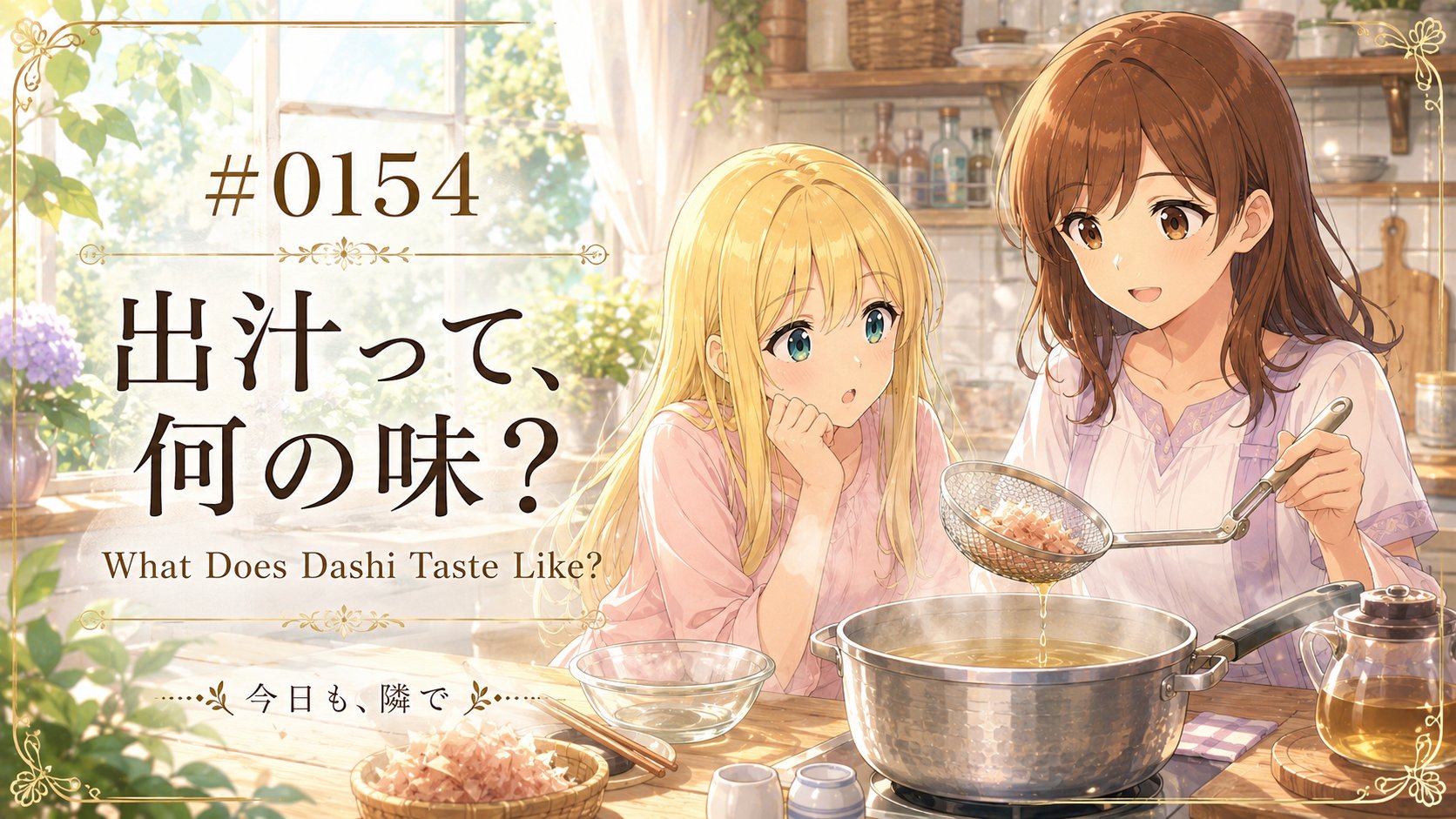
📕 はじめに|A small beginning
出汁は、
はっきり前に出る味ではない。
でも、そこにあると、
料理の味が少し深くなる。
しょっぱいだけではない。
甘いだけでもない。
味の奥に、
静かにいるもの。
今日は、出汁から始まる、
夏の小さな会話。
はっきり前に出る味ではない。
でも、そこにあると、
料理の味が少し深くなる。
しょっぱいだけではない。
甘いだけでもない。
味の奥に、
静かにいるもの。
今日は、出汁から始まる、
夏の小さな会話。
Dashi is not a flavor
that stands clearly in front.
But when it is there,
food tastes a little deeper.
It is not just salty.
It is not simply sweet, either.
It is something quiet
deep inside the flavor.
Today’s small summer conversation
begins with dashi.
that stands clearly in front.
But when it is there,
food tastes a little deeper.
It is not just salty.
It is not simply sweet, either.
It is something quiet
deep inside the flavor.
Today’s small summer conversation
begins with dashi.
📚 今日も、隣で|Today, by your side
夏のお昼。そうめんのつゆを少しだけ味見して、さくらが首をかしげた。
A summer lunch. After tasting a little dipping sauce, Sakura tilted her head.
ねぇ、すみれ。
Hey, Sumire.
なに?
What?
出汁ってさ。
Dashi, you know.
うん。
Yes?
何の味?
What does it taste like?
……すごく簡単そうで、
けっこう難しい質問だね。
けっこう難しい質問だね。
…That sounds very simple,
but it is actually a pretty difficult question.
but it is actually a pretty difficult question.
しょっぱいわけじゃないし、
甘いわけでもないでしょ?
甘いわけでもないでしょ?
It is not exactly salty,
and it is not sweet either, right?
and it is not sweet either, right?
うん。
出汁そのものは、
塩や砂糖みたいに強い味ではないね。
出汁そのものは、
塩や砂糖みたいに強い味ではないね。
Right.
Dashi itself
does not have a strong flavor like salt or sugar.
Dashi itself
does not have a strong flavor like salt or sugar.
じゃあ、何味?
Then what flavor is it?
旨みの味、かな。
Maybe the taste of umami.
旨み。
Umami.
かつおや昆布から出る、
料理をおいしく感じさせる味。
料理をおいしく感じさせる味。
It is a flavor that comes from
things like katsuobushi and kombu,
and makes food taste better.
things like katsuobushi and kombu,
and makes food taste better.
主張は強くないけど、
いると全体がおいしくなる感じ?
いると全体がおいしくなる感じ?
It does not stand out strongly,
but when it is there,
everything tastes better?
but when it is there,
everything tastes better?
そうそう。
前に言った、
支えてくれる味に近いね。
前に言った、
支えてくれる味に近いね。
Exactly.
It is close to what we talked about before,
a flavor that supports everything.
It is close to what we talked about before,
a flavor that supports everything.
出汁って、
味の裏方さんなんだ。
味の裏方さんなんだ。
So dashi is
a backstage helper for flavor.
a backstage helper for flavor.
いい言い方かも。
That may be a nice way to say it.
でも、裏方さんがいないと、
主役が寂しくなる。
主役が寂しくなる。
But without the backstage helper,
the main character feels a little lonely.
the main character feels a little lonely.
うん。
麺も、つゆも、煮物も、
出汁があると味がまとまりやすい。
麺も、つゆも、煮物も、
出汁があると味がまとまりやすい。
Yes.
Noodles, dipping sauce, and simmered dishes
all come together more easily when dashi is there.
Noodles, dipping sauce, and simmered dishes
all come together more easily when dashi is there.
そっか。
出汁は、何の味?って聞いたけど。
出汁は、何の味?って聞いたけど。
I see.
I asked what dashi tastes like, but…
I asked what dashi tastes like, but…
うん。
Yes?
答えは、
「おいしくなる前の静かな味」かも。
「おいしくなる前の静かな味」かも。
Maybe the answer is
“a quiet flavor before something becomes delicious.”
“a quiet flavor before something becomes delicious.”
……今日は、さくらの方が詩人だね。
…Today, you are the poetic one.
麦茶から成長した。
I grew from barley tea.
そこからつながってたんだ。
So it was connected from there.
うん。
麦茶は夏の気分。
そうめんは夏のお昼。
つゆは支える味。
麦茶は夏の気分。
そうめんは夏のお昼。
つゆは支える味。
Yes.
Barley tea is the feeling of summer.
Somen is a summer lunch.
Dipping sauce is a supporting flavor.
Barley tea is the feeling of summer.
Somen is a summer lunch.
Dipping sauce is a supporting flavor.
それで、出汁は?
And dashi is?
おいしさの土台。
The foundation of deliciousness.
……それ、かなりいいまとめ。
…That is a really good summary.
やった。
今日は出汁に近づいた。
今日は出汁に近づいた。
Yay.
Today, I got closer to dashi.
Today, I got closer to dashi.
勝ち負けじゃないけどね。
It is not about winning or losing, though.
じゃあ、もうひと口。
Then one more taste.
うん。
今度は、少しゆっくり味わってみて。
今度は、少しゆっくり味わってみて。
Yes.
This time, try tasting it a little more slowly.
This time, try tasting it a little more slowly.
うん。
……あ、なんかいる。
……あ、なんかいる。
Okay.
…Oh, something is there.
…Oh, something is there.
何が?
What is there?
味の奥に、
静かな人がいる。
静かな人がいる。
Deep inside the flavor,
there is someone quiet.
there is someone quiet.
それが、出汁かもね。
That might be dashi.
📘 最後に|Afterword
出汁は、
強く目立つ味ではない。
けれど、そこにあると、
料理の味がまとまり、
少しだけ深くなる。
かつおの香り。
昆布の旨み。
それらが重なって、
食べものの奥に、
静かな味を作っている。
主役ではないけれど、
主役を支えるもの。
出汁とは、
そんなおいしさの土台なのかもしれない。
強く目立つ味ではない。
けれど、そこにあると、
料理の味がまとまり、
少しだけ深くなる。
かつおの香り。
昆布の旨み。
それらが重なって、
食べものの奥に、
静かな味を作っている。
主役ではないけれど、
主役を支えるもの。
出汁とは、
そんなおいしさの土台なのかもしれない。
Dashi is not a flavor
that stands out strongly.
But when it is there,
the taste of a dish comes together
and becomes a little deeper.
The aroma of katsuobushi.
The umami of kombu.
When they overlap,
they create a quiet flavor
deep inside the food.
It is not the main character,
but it supports the main character.
Maybe dashi is
that kind of foundation of deliciousness.
that stands out strongly.
But when it is there,
the taste of a dish comes together
and becomes a little deeper.
The aroma of katsuobushi.
The umami of kombu.
When they overlap,
they create a quiet flavor
deep inside the food.
It is not the main character,
but it supports the main character.
Maybe dashi is
that kind of foundation of deliciousness.
コメント