📖 Study Guide
Learn Japanese through stories.
These stories include Japanese culture,
daily life, travel experiences,
and conversations between people.
1. Read the English text.
2. Read the Japanese text.
3. Use Romaji if needed.
4. Review the vocabulary.
🌸 Story
Outside the window, it is slowly getting darker.
窓の外が、少しずつ暗くなっていく。
Mado no soto ga, sukoshi zutsu kuraku natte iku.


it’s been getting dark earlier, hasn’t it?
暗くなるの早くなったよね。
kuraku naru no hayaku natta yo ne.
In summer,
it stayed light much later.
夏はもっと遅くまで
明るかったのにね。
Natsu wa motto osoku made
akarukatta noni ne.
when day and night are the same length, right?
昼と夜が同じ長さになる日だよね?
hiru to yoru ga onaji nagasa ni naru hi da yo ne?
…I think.
……たぶん。
…tabun.

they aren’t exactly the same, nya.
ぴったり同じではないにゃ。
pittari onaji de wa nai nya.
day and night are
almost the same length, nya.
But in Japan,
daytime is actually
a little longer, nya.
昼と夜の長さが
ほぼ同じになるころにゃ。
でも日本では、
実際には昼の方が
少し長くなるにゃ。
hiru to yoru no nagasa ga
hobo onaji ni naru koro nya.
Demo Nihon de wa,
jissai ni wa hiru no hō ga
sukoshi nagaku naru nya.
I always thought
they were exactly half and half. 💦
ずっと半分ずつだと
思ってた💦
Zutto hanbun zutsu da to
omotteta. 💦
what happens after the Autumn Equinox?
秋分の日を過ぎると?
Shūbun no Hi o sugiru to?
start getting longer, nya.
長くなっていくにゃ。
nagaku natte iku nya.
autumn nights start to feel longer.
秋の夜が長く感じるようになるんだね。
aki no yoru ga nagaku kanjiru yō ni naru n da ne.
That connects to
“the long autumn nights” we talked about before. 😊
この前の
「秋の夜長」にもつながった😊
Kono mae no
“aki no yonaga” ni mo tsunagatta. 😊
Sunset comes a little earlier each day.
Little by little,
the seasons keep moving forward.
少しずつ早くなる夕暮れ。
季節は毎日ほんの少しずつ、
次の季節へ進んでいる。
Sukoshi zutsu hayaku naru yūgure.
Kisetsu wa mainichi honno sukoshi zutsu,
tsugi no kisetsu e susunde iru.
💭 Story Note
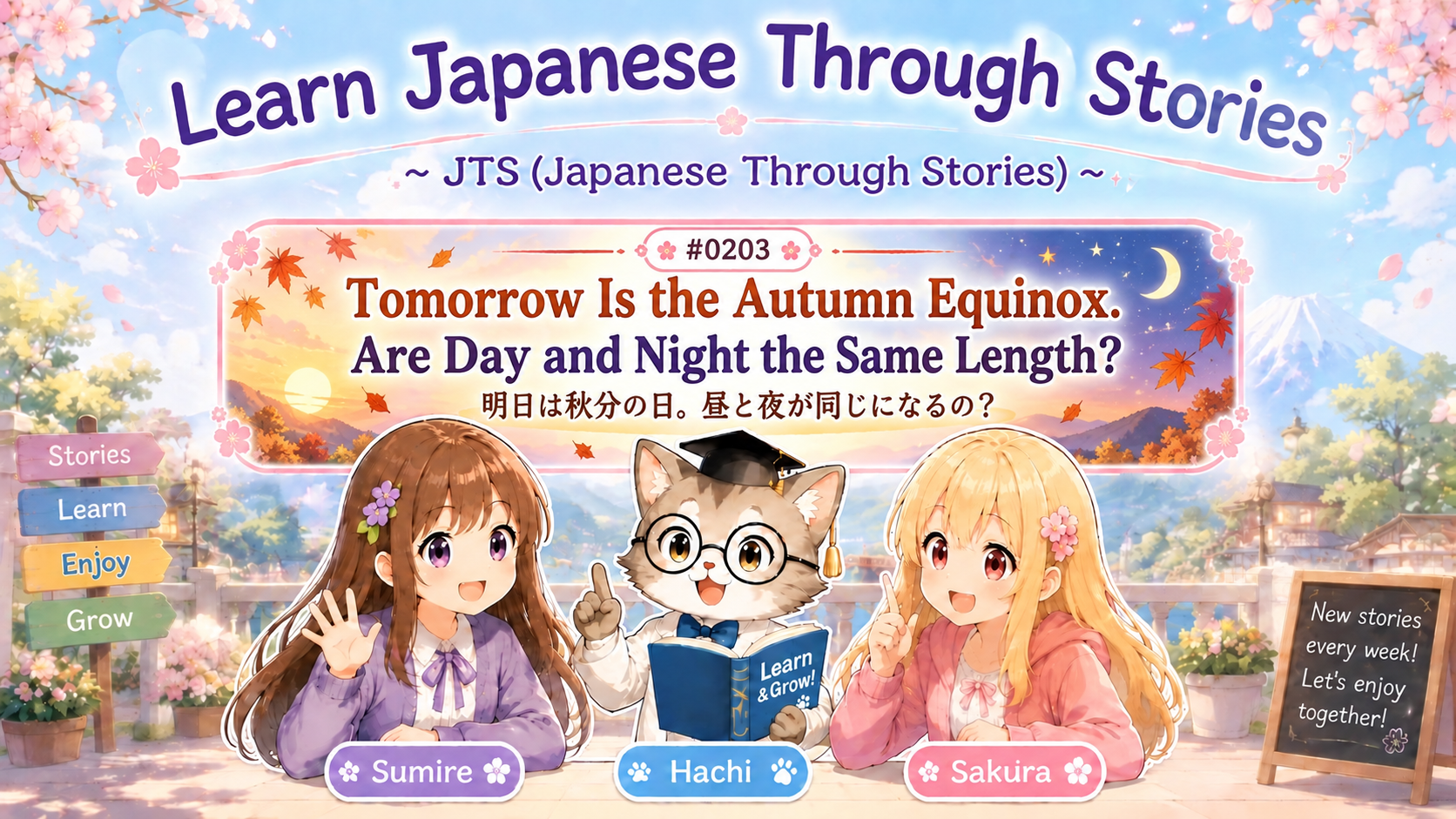
The Autumn Equinox is called
「秋分の日」(Shūbun no Hi) in Japanese.
Around this time,
day and night become almost the same length.
In the story,
Hachi explains that they are not exactly equal,
and that daytime is actually a little longer in Japan.
After the Autumn Equinox,
the nights gradually become longer.
This change is easy to notice in everyday life.
Sunset comes earlier,
the evenings feel longer,
and the air slowly begins to feel more like autumn.
In Japanese,
there is also the expression:
「秋の夜長」(aki no yonaga)
It refers to the long nights of autumn.
Rather than describing one sudden change,
expressions like this reflect the feeling
that the season is slowly moving
from summer into autumn.
📚 Vocabulary
Here are some words and expressions from this story.
They are useful for talking about the autumn season
and the changing length of day and night.
| English | Japanese | Romaji |
|---|---|---|
| Autumn Equinox | 秋分の日 | shūbun no hi |
| dusk / evening twilight | 夕暮れ | yūgure |
| gradually | だんだん | dandan |
| exactly / perfectly | ぴったり | pittari |
| long autumn nights | 秋の夜長 | aki no yonaga |
「秋の夜長」(aki no yonaga) literally refers to
the long nights of autumn.
In Japanese, this expression is often used
when talking about the feeling of having more time
during the long, quiet evenings of autumn.
It does not simply mean that the night is long.
It can also suggest a calm seasonal atmosphere,
such as spending an evening reading,
listening to music,
or enjoying a quiet hobby.
For example:
「秋の夜長に本を読む。」
Aki no yonaga ni hon o yomu.
“I read books during the long autumn nights.”
「秋の夜長をゆっくり楽しもう。」
Aki no yonaga o yukkuri tanoshimō.
“Let’s relax and enjoy the long autumn nights.”
🔰 Mix Words and Feel Their Meaning|ことばを混ぜて、感覚をつかもう
Today’s phrase is 「秋の夜長」.
Try mixing it into English:
“I like reading during 秋の夜長.”
“Listening to music is perfect for 秋の夜長.”
“These days, some people may spend 秋の夜長 on their phones or computers.”
The goal is not to make perfect Japanese.
Think about what 「秋の夜長」 feels like.
It is more than simply saying
that autumn nights are long.
It can suggest having more time in the evening
to read, listen to music, watch something,
or quietly enjoy your favorite activities.
「秋の夜長」 carries
a calm, seasonal feeling of autumn.

コメント