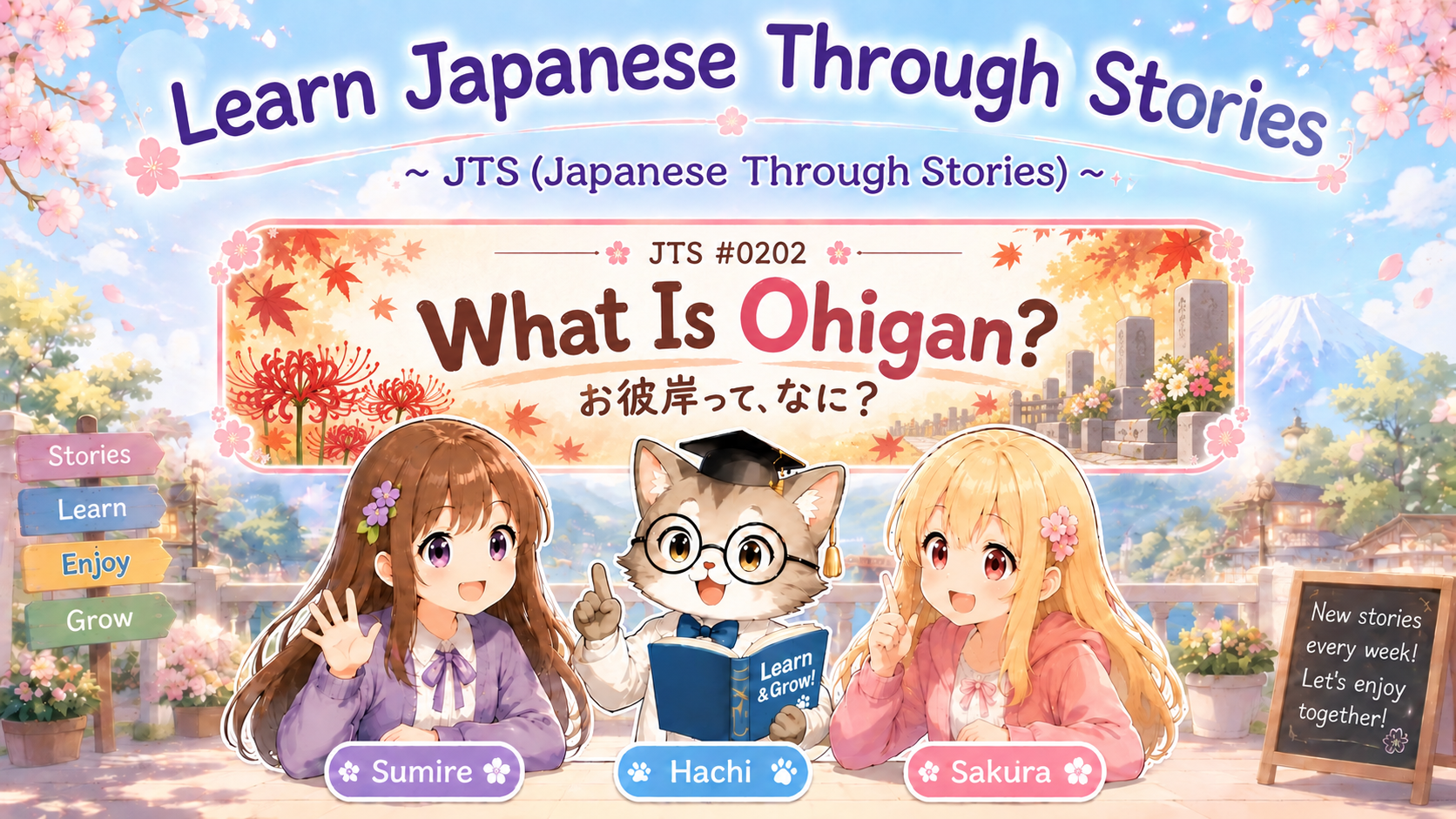
📖 Study Guide
Learn Japanese through stories.
These stories include Japanese culture,
daily life, travel experiences,
and conversations between people.
1. Read the English text.
2. Read the Japanese text.
3. Use Romaji if needed.
4. Review the vocabulary.
🌸 Story


Wasn’t it Obon
just a little while ago?
この前、
お盆じゃなかった?
Kono mae,
Obon janakatta?
kind of close together?
近くない?
chikaku nai?
People visit graves for both,
so they do seem a little similar.
どっちもお墓参りしたりするし、
ちょっと似てるよね。
Dotchi mo ohakamairi shitari suru shi,
chotto niteru yo ne.
our ancestors come back, right?
ご先祖さまが帰ってくるんだよね?
gosenzosama ga kaette kuru n da yo ne?
is it more like
we go to visit them?
こっちから、
会いに行く感じ?
kotchi kara,
ai ni iku kanji?
About that…
そのあたりは……
Sono atari wa…
please explain! 😊
お願いしまーす😊
onegai shimāsu. 😊

Ohigan happens twice a year,
in spring and autumn.
It lasts for seven days,
with the spring or autumn equinox in the middle
and three days before and after, nya.
お彼岸は、
春と秋の年に二回あるにゃ。
春分の日と秋分の日を真ん中にして、
前後三日ずつを合わせた
七日間がお彼岸にゃ。
Ohigan wa,
haru to aki no toshi ni nikai aru nya.
Shunbun no Hi to Shūbun no Hi o mannaka ni shite,
zengo mikka zutsu o awaseta
nanokakan ga Ohigan nya.
Obon is known as a time
to welcome ancestors back
and honor them.
Ohigan is a time in Japan
when people remember their ancestors
and visit their graves, nya.
お盆は、
ご先祖さまをお迎えして
供養する行事として知られているにゃ。
お彼岸は、
ご先祖さまを思い、
お墓参りをする時期として
日本では親しまれているにゃ。
Obon wa,
gosenzosama o omukae shite
kuyō suru gyōji to shite shirarete iru nya.
Ohigan wa,
gosenzosama o omoi,
ohakamairi o suru jiki to shite
Nihon de wa shitashimarete iru nya.
but they’re a little different.
似ているようで少し違うんだね。
nite iru yō de sukoshi chigau n da ne.
Come to think of it…
People say,
“Atsusa samusa mo higan made,” right?
そういえば……
「暑さ寒さも彼岸まで」って
言うよね?
Sō ieba…
“Atsusa samusa mo higan made” tte
iu yo ne?
So the “higan” in that saying
is this Ohigan.
あの「彼岸」って、
このお彼岸なんだ。
Ano “higan” tte,
kono Ohigan nan da.
Around the end of spring Ohigan,
the cold begins to ease.
Around the end of autumn Ohigan,
the heat begins to ease.
For a long time,
this saying has been used
to describe the changing seasons, nya.
春のお彼岸を過ぎるころには
寒さが和らぎ、
秋のお彼岸を過ぎるころには
暑さが和らぐ。
昔から、
季節の変わり目を表す言葉として
使われてきたにゃ。
Haru no Ohigan o sugiru koro ni wa
samusa ga yawaragi,
aki no Ohigan o sugiru koro ni wa
atsusa ga yawaragu.
Mukashi kara,
kisetsu no kawarime o arawasu kotoba to shite
tsukawarete kita nya.
it should start getting cooler soon. 😊
そろそろ涼しくなるんだね😊
sorosoro suzushiku naru n da ne. 😊
there are still mosquitoes around… 💦
まだ蚊がいるんだよね……💦
mada ka ga iru n da yo ne… 💦
don’t understand
“Atsusa samusa mo higan made,” nya.
「暑さ寒さも彼岸まで」は
通じないのかもしれないにゃ。
“Atsusa samusa mo higan made” wa
tsūjinai no kamo shirenai nya.
💭 Story Note
Ohigan is a traditional period in Japan that comes twice a year,
around the spring and autumn equinoxes.
Each Ohigan lasts for seven days:
the equinox itself,
plus three days before and three days after.
During this time,
many people visit family graves
and remember their ancestors.
Ohigan may seem similar to Obon,
because both are connected with ancestors
and grave visits.
However, they have different traditions and meanings.
Obon is often described as a time
when the spirits of ancestors return to visit their families.
Ohigan, on the other hand,
is strongly connected with the spring and autumn equinoxes
and with remembering ancestors through visits and reflection.
There is also a well-known Japanese saying:
“Atsusa samusa mo higan made.”
It means that the heat of summer
and the cold of winter tend to ease
around the time of Ohigan.
For many people in Japan,
Ohigan is connected not only with family and ancestors,
but also with the feeling that the seasons are beginning to change.
📚 Vocabulary
Here are some words and expressions from this story.
They are useful for understanding Ohigan,
Japanese seasonal traditions, and family customs.
| English | Japanese | Romaji |
|---|---|---|
| Ohigan | お彼岸 | ohigan |
| grave visit | お墓参り | ohakamairi |
| ancestors | ご先祖さま | gosenzosama |
| spring equinox | 春分の日 | shunbun no hi |
| autumn equinox | 秋分の日 | shūbun no hi |
「お彼岸」(ohigan) is a word used for a traditional period
around the spring and autumn equinoxes in Japan.
It comes twice a year,
and many people visit family graves
and remember their ancestors during this time.
In everyday Japanese,
people usually say 「お彼岸」 with the polite prefix 「お」.
For example:
「お彼岸にお墓参りに行きます。」
Ohigan ni ohakamairi ni ikimasu.
“I visit the family grave during Ohigan.”
「もうすぐお彼岸だね。」
Mō sugu ohigan da ne.
“Ohigan is coming soon.”
「お彼岸は春と秋にあります。」
Ohigan wa haru to aki ni arimasu.
“Ohigan comes in spring and autumn.”
The word 「彼岸」 can also appear by itself,
such as in the saying:
「暑さ寒さも彼岸まで」
But when talking about the seasonal tradition in everyday conversation,
「お彼岸」 sounds natural and familiar.
🔰 Mix Words and Feel Their Meaning|ことばを混ぜて、感覚をつかもう
Today’s word is 「お彼岸」.
Try mixing it into English:
“We visit our family graves during お彼岸.”
“There is お彼岸 in both spring and autumn.”
“お彼岸 makes me feel that the season is changing.”
The goal is not to make perfect Japanese.
Think about what 「お彼岸」 feels like.
It is a time connected with remembering ancestors,
visiting family graves,
and the changing seasons.
If someone asks,
“What is お彼岸?”
try explaining it in your own words.
That is one way
to begin making the word part of your Japanese.
コメント