📖 Study Guide
Learn Japanese through stories.
These stories include Japanese culture,
daily life, travel experiences,
and conversations between people.
1. Read the English text.
2. Read the Japanese text.
3. Use Romaji if needed.
4. Review the vocabulary.
🌸 Story
There is ohagi on the table.
テーブルの上には、おはぎ。
Tēburu no ue ni wa, ohagi.


you look happy.
嬉しそうだね。
ureshisō da ne.
…Wait.
……あれ?
…Are?
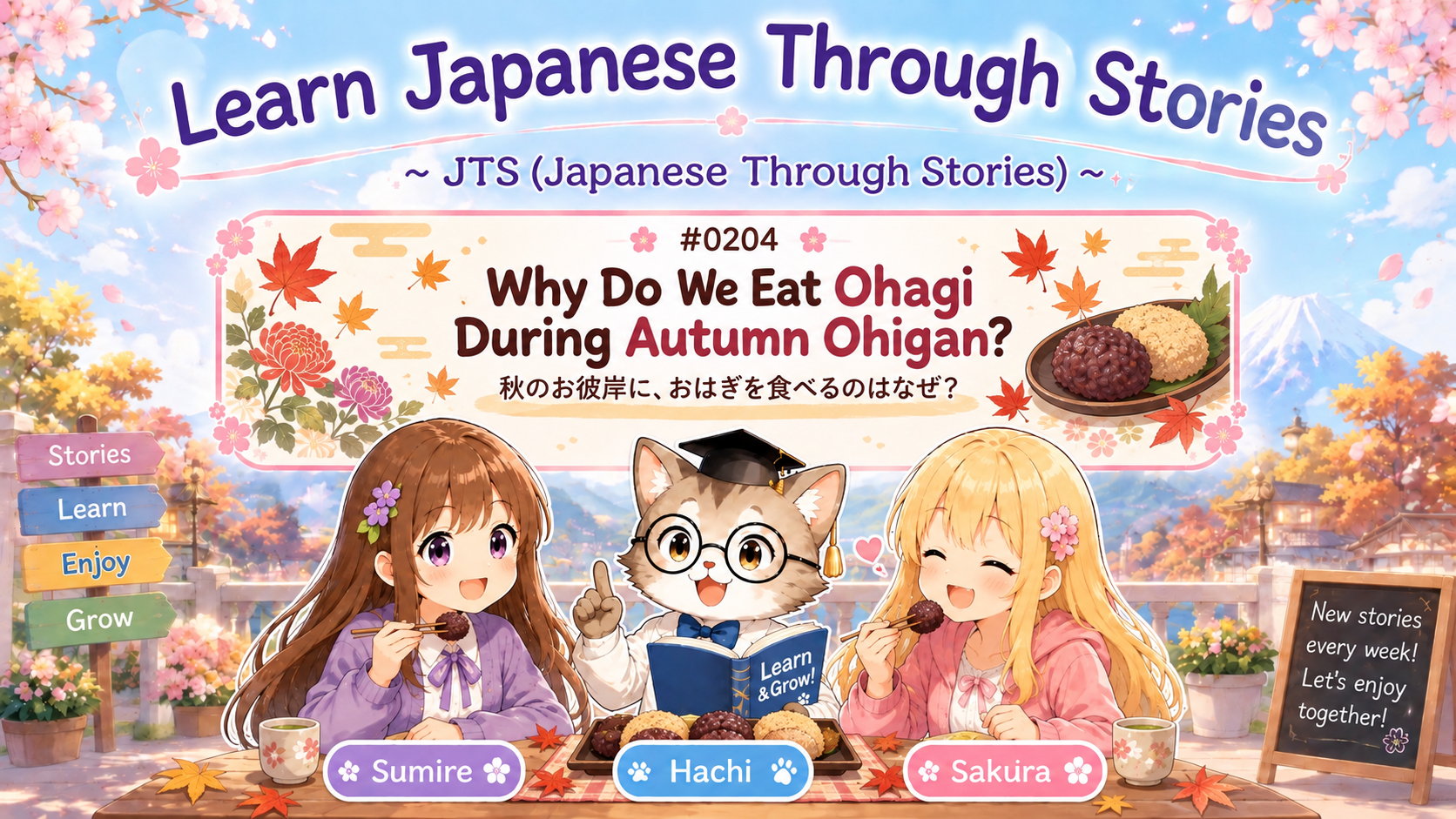
why do we eat ohagi
during Ohigan?
なんでお彼岸に
おはぎを食べるんだろう?
nande Ohigan ni
ohagi o taberu n darō?
Now that you mention it.
言われてみれば。
Iwarete mireba.

For a long time in Japan,
people believed that
the red color of azuki beans
could ward off misfortune, nya.
昔から日本では、
小豆の赤い色には、
災いを遠ざける力があると
考えられてきたにゃ。
Mukashi kara Nihon de wa,
azuki no akai iro ni wa,
wazawai o tōzakeru chikara ga aru to
kangaerarete kita nya.
sugar and rice were precious
in the past, nya.
昔は砂糖やお米も貴重だったにゃ。
mukashi wa satō ya okome mo kichō datta nya.
people offered food made with
azuki beans and rice
to their ancestors
to show their gratitude, nya.
小豆とお米を使ったものを
ご先祖さまにお供えして、
感謝の気持ちを表したと
いわれているにゃ。
azuki to okome o tsukatta mono o
gosenzosama ni osonae shite,
kansha no kimochi o arawashita to
iwarete iru nya.
we eat ohagi during Ohigan.
お彼岸におはぎなんだね。
Ohigan ni ohagi nan da ne.
We eat the same thing
during spring Ohigan too, right?
春のお彼岸にも、
同じの食べるよね?
Haru no Ohigan ni mo,
onaji no taberu yo ne?
Botamochi?
ぼたもち?
Botamochi?
Are ohagi
and botamochi different?
おはぎと、
ぼたもちって違うの?
Ohagi to,
botamochi tte chigau no?
they’re basically the same thing, nya.
基本的には同じものにゃ。
kihonteki ni wa onaji mono nya.
Then,
why do they have different names?
じゃあ、
なんで名前が違うの?
Jā,
nande namae ga chigau no?
botan, the peony that blooms in spring.
“Ohagi” comes from
hagi, the bush clover that blooms in autumn.
The names have traditionally changed
with the seasonal flowers, nya.
「ぼたもち」。
秋に咲く萩から
「おはぎ」。
季節の花にちなんで
呼び分けられてきたにゃ。
“botamochi.”
Aki ni saku hagi kara
“ohagi.”
Kisetsu no hana ni chinande
yobiwakerarete kita nya.
Even the names
have their own seasons. 😊
名前にも
季節があるんだね😊
Namae ni mo
kisetsu ga aru n da ne. 😊
Since it’s autumn,
today it’s “ohagi.”
秋だから、
今日は「おはぎ」。
Aki dakara,
kyō wa “ohagi.”
we’ll have to eat “botamochi” too.
「ぼたもち」も食べなきゃね。
“botamochi” mo tabenakya ne.
you just want to eat it, don’t you? 💦
食べたいだけでしょ💦
tabetai dake desho. 💦
💭 Story Note
In Japan, ohagi is often eaten during Ohigan,
a seasonal Buddhist period around the spring and autumn equinoxes.
In the story,
Hachi explains that the red color of azuki beans
was traditionally believed to help keep misfortune away.
Rice and sugar were also valuable foods in the past.
Because of this,
foods made with azuki beans and rice
came to be offered to ancestors
as a way of showing gratitude.
There is also an interesting seasonal difference in the name.
In spring,
the food is often called 「ぼたもち」(botamochi),
a name connected with the peony flower, 「牡丹」(botan).
In autumn,
it is often called 「おはぎ」(ohagi),
a name connected with bush clover, 「萩」(hagi).
The food itself is basically the same,
but the names reflect the flowers of each season.
This is one example of how Japanese food culture
can carry a sense of season even in the name.
📚 Vocabulary
Here are some words and expressions from this story.
They are useful for understanding Ohigan,
Japanese seasonal food, and family traditions.
| English | Japanese | Romaji |
|---|---|---|
| Ohigan | お彼岸 | ohigan |
| ohagi | おはぎ | ohagi |
| azuki beans | 小豆 | azuki |
| offering | お供え | osonae |
| botamochi | ぼたもち | botamochi |
「お供え」(osonae) means an offering
placed at a Buddhist altar, grave,
or another place to show respect.
Food, flowers, and other items
can be given as 「お供え」.
In Japanese,
the verb 「お供えする」(osonae suru)
means “to make an offering” or “to offer something.”
For example:
「ご先祖さまにおはぎをお供えする。」
Gosenzosama ni ohagi o osonae suru.
“We offer ohagi to our ancestors.”
「お花をお供えしました。」
Ohana o osonae shimashita.
“I offered flowers.”
「お供え」 is often connected with
remembering someone,
showing respect,
or expressing gratitude.
🔰 Mix Words and Feel Their Meaning|ことばを混ぜて、感覚をつかもう
Today’s word is 「お供え」.
Try mixing it into English:
“We put ohagi as an お供え.”
“Flowers can also be an お供え.”
“This お供え is for our ancestors.”
The goal is not to make perfect Japanese.
Think about what 「お供え」 feels like.
It is not simply something
placed at an altar or grave.
It can carry feelings of
respect,
remembrance,
and gratitude.
If someone asks,
“What is お供え?”
try explaining
why people give it,
not only what it is.
That is one way
to begin making the word
part of your Japanese.
コメント