📖 Study Guide
Learn Japanese through stories.
These stories include Japanese culture,
daily life, travel experiences,
and conversations between people.
1. Read the English text.
2. Read the Japanese text.
3. Use Romaji if needed.
4. Review the vocabulary.
🌸 Story
Sakura is looking up at the sky
through the window.
窓の外を見ながら、
さくらが空を見上げている。
Mado no soto o minagara,
Sakura ga sora o miagete iru.


Let’s enjoy moon viewing. 😊
お月見しようよ😊
Otsukimi shiyō yo. 😊
you can’t leave that out. 💦
それは外せないのね💦
sore wa hazusenai no ne. 💦
The susuki we talked about before.
この前話した、すすき。
Kono mae hanashita, susuki.
we’ll prepare susuki and dango…
すすきとお団子を用意して……
susuki to odango o yōi shite…
Somehow,
it really feels like autumn.
なんだか、
秋って感じがするね。
Nandaka,
aki tte kanji ga suru ne.
we can see it clearly tomorrow.
きれいに見えるといいね。
kirei ni mieru to ii ne.
💭 Story Note
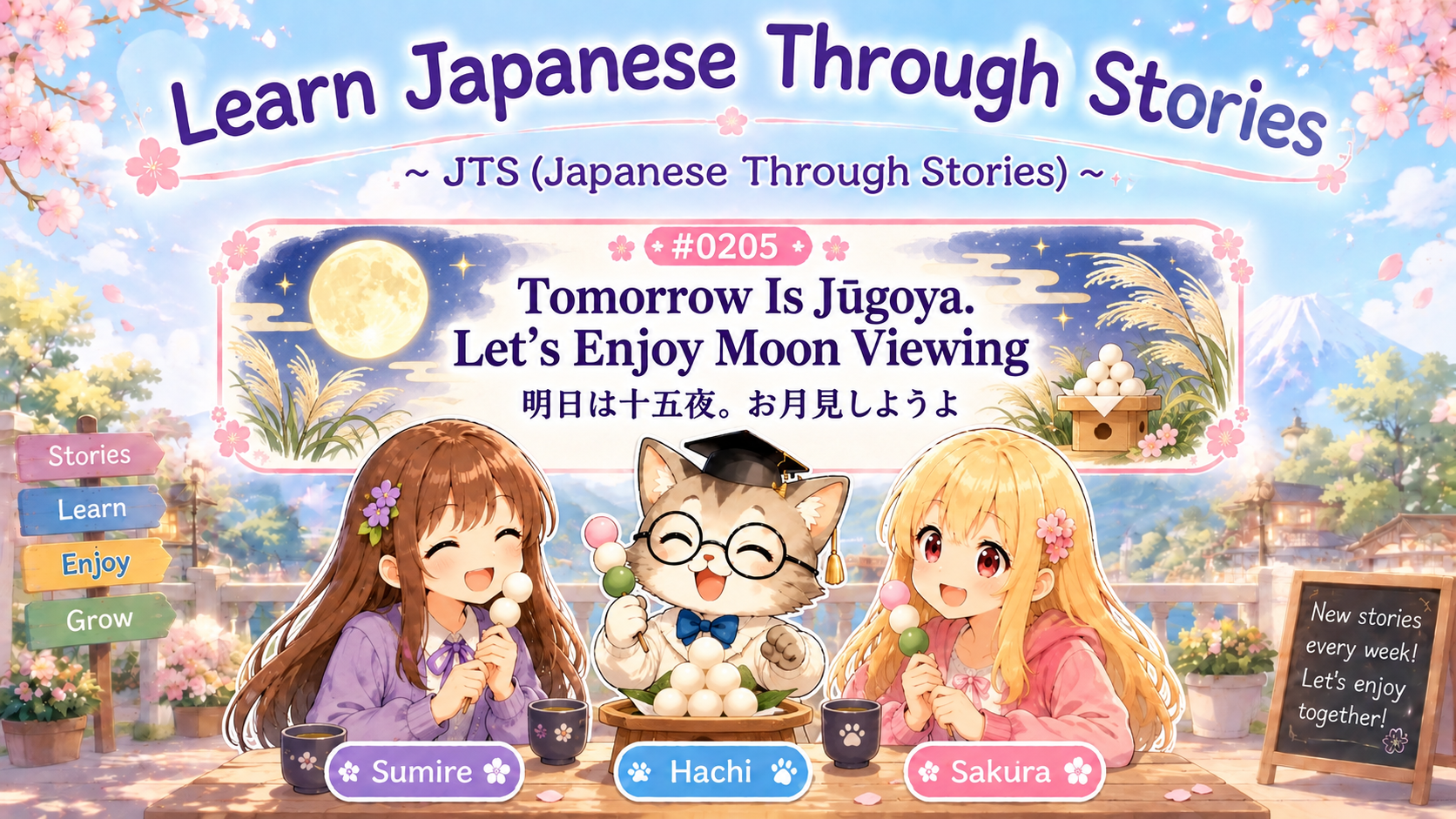
Jūgoya is connected with moon viewing in Japan.
In this story,
Sakura and Sumire prepare for the evening
with dango and susuki grass.
These are familiar parts of the image of Jūgoya
in Japanese seasonal culture.
The Japanese expression 「お月見」(otsukimi)
means enjoying or viewing the moon.
For Sakura and Sumire,
preparing dango and susuki,
then looking up at the moon,
makes the evening feel like autumn.
It is a simple seasonal moment,
but one that can make people notice
the changing season.
📚 Vocabulary
Here are some words and expressions from this story.
They are useful for talking about Jūgoya,
moon viewing, and autumn in Japan.
| English | Japanese | Romaji |
|---|---|---|
| Jūgoya | 十五夜 | jūgoya |
| moon viewing | お月見 | otsukimi |
| dango | お団子 | odango |
| susuki grass | すすき | susuki |
| moon | 月 | tsuki |
「お月見」(otsukimi) means enjoying or viewing the moon.
The word comes from:
「月」(tsuki) = moon
「見る」(miru) = to see or look at
In everyday Japanese,
「お月見」 is often used when talking about
enjoying the moon as a seasonal activity.
For example:
「明日はお月見しよう。」
Ashita wa otsukimi shiyō.
“Let’s enjoy moon viewing tomorrow.”
「お月見で月を見る。」
Otsukimi de tsuki o miru.
“We watch the moon during moon viewing.”
In this story,
Sakura and Sumire prepare dango and susuki
and look forward to seeing the moon.
「お月見」 is not only about seeing the moon.
It can also carry the feeling
of enjoying an autumn evening.
🔰 Mix Words and Feel Their Meaning|ことばを混ぜて、感覚をつかもう
Today’s word is 「お月見」.
Try mixing it into English:
“Tomorrow, let’s enjoy お月見.”
“We prepared dango and susuki for お月見.”
“お月見 makes the autumn evening feel special.”
The goal is not to make perfect Japanese.
Think about what 「お月見」 feels like.
It is more than simply seeing the moon.
It is a seasonal moment
for looking at the moon
and enjoying the autumn atmosphere.
If someone asks,
“What is お月見?”
try explaining
not only that you look at the moon,
but also that you enjoy the season.
That is one way
to begin making the word
part of your Japanese.

コメント