📖 Study Guide
Learn Japanese through stories.
These stories include Japanese culture,
daily life, travel experiences,
and conversations between people.
1. Read the English text.
2. Read the Japanese text.
3. Use Romaji if needed.
4. Review the vocabulary.
🌸 Story
Sakura and Sumire are talking.
さくらとすみれが話している。
Sakura to Sumire ga hanashite iru.


we’re having the sports festival
on Sports Day, right?
スポーツの日に
体育祭やるんだよね。
Supōtsu no Hi ni
taiikusai yaru n da yo ne.
It kind of feels like
we’re losing a day off.
なんだか、
1日損した気分。
Nandaka,
ichinichi son shita kibun.
It’s supposed to be a day off.
せっかくの休みなのに。
Sekkaku no yasumi na noni.
why do people say
“autumn is the season for sports”?
なんで
「スポーツの秋」なんだろう?
nande
“supōtsu no aki” nan darō?
Good question.
たしかに。
Tashika ni.
in spring,
in summer,
and in winter too.
春でもするし、
夏でもするし、
冬でもするよね。
haru demo suru shi,
natsu demo suru shi,
fuyu demo suru yo ne.
autumn is for reading,
autumn is for eating,
and autumn is for sports.
Is everything about autumn? 🤔
読書の秋、
食欲の秋、
スポーツの秋。
なんでも秋なのかな?🤔
dokusho no aki,
shokuyoku no aki,
supōtsu no aki.
Nandemo aki na no kana? 🤔
Autumn
sure is busy. 🤣
秋、
忙しいね🤣
Aki,
isogashii ne. 🤣
Eat,
read,
run…
There’s no time to rest! 💦
食べて、
読んで、
走って……
休む暇ないじゃん💦
Tabete,
yonde,
hashitte…
Yasumu hima nai jan. 💦
you have to do all of them. 🤣
いいと思うけど🤣
ii to omou kedo. 🤣
💭 Story Note
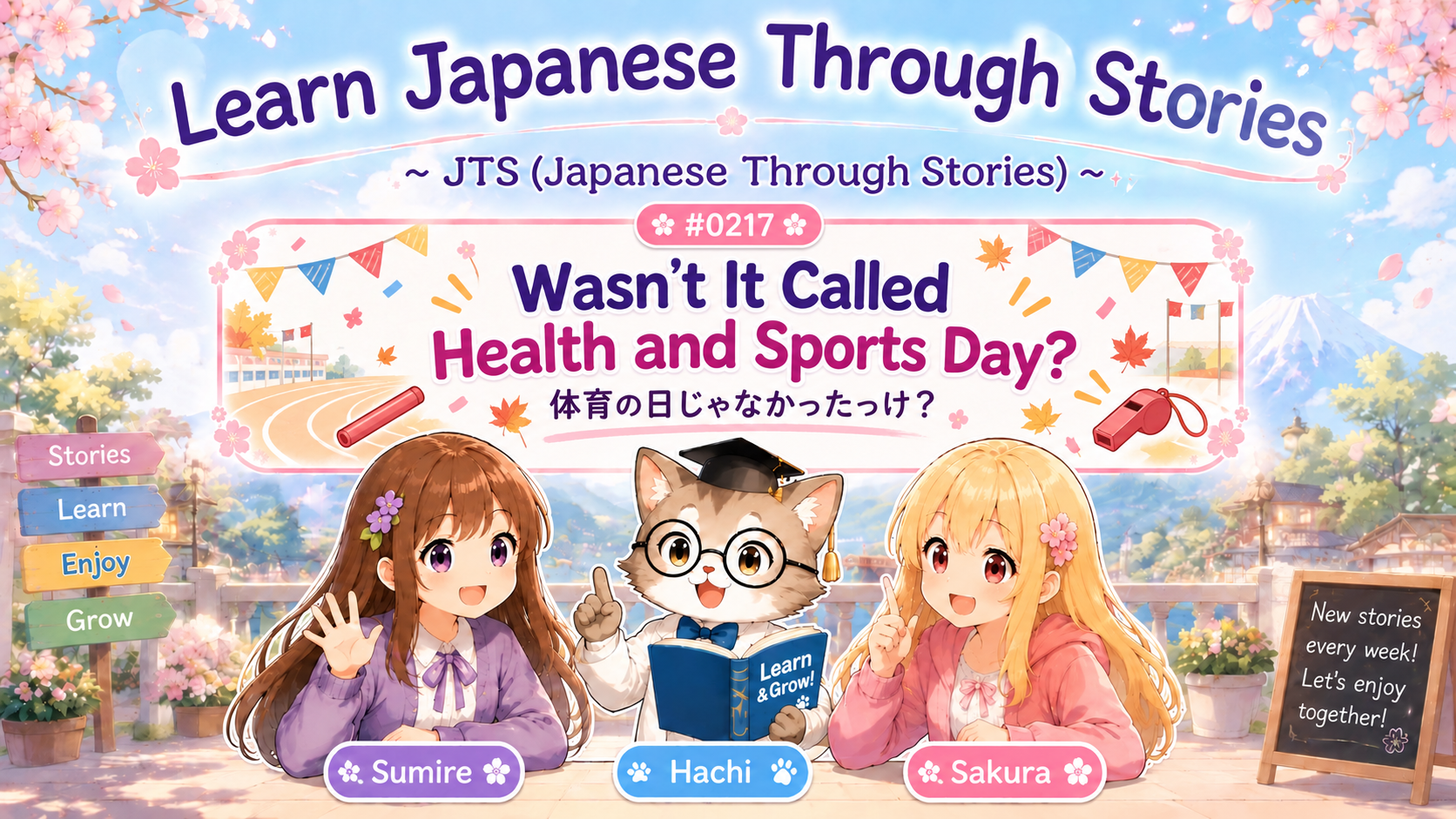
### Why Is Autumn the Season for Sports?
In Japan, people often say:
「スポーツの秋」
supōtsu no aki
This means
“autumn is the season for sports.”
Autumn is generally seen as a comfortable season
for outdoor activities,
because the weather is usually cooler
than in summer
and not yet as cold as winter.
There is also an important connection
between autumn and sports in modern Japan.
The opening ceremony
of the 1964 Tokyo Olympics
was held on October 10.
That date later became
「体育の日」(Taiiku no Hi),
or “Health and Sports Day.”
Today, the holiday is called
「スポーツの日」(Supōtsu no Hi),
or “Sports Day.”
So for many people in Japan,
autumn and sports have become
closely connected
through both the season
and the history of the holiday.
📚 Vocabulary
Here are some words and expressions from this story.
| English | Japanese | Romaji |
|---|---|---|
| school sports festival | 体育祭 | taiikusai |
| Sports Day | スポーツの日 | supōtsu no hi |
| autumn is the season for sports | スポーツの秋 | supōtsu no aki |
| since it is a special chance / after all | せっかく | sekkaku |
| no time to rest | 休む暇ない | yasumu hima nai |
「せっかく」(sekkaku)
is used when something is special,
valuable, or took some effort,
and you do not want it to go to waste.
It is often used when
you have a good opportunity,
but something does not go as expected.
For example:
「せっかくの休みなのに。」
Sekkaku no yasumi na noni.
“It’s such a nice day off, but…”
「せっかく来たから、楽しもう。」
Sekkaku kita kara, tanoshimō.
“Since we came all this way, let’s enjoy it.”
In this story,
Sakura says:
「せっかくの休みなのに。」
She feels that Sports Day
should be a nice day off,
so having the school sports festival
on that day feels a little disappointing.
「せっかく」 often carries the feeling of:
“It would be a shame to waste this.”
🔰 Mix Words and Feel Their Meaning|ことばを混ぜて、感覚をつかもう
Today’s expression is:
「せっかく」(sekkaku)
Try mixing it into English.
“It’s せっかく a day off,
but we have the sports festival.”
“We came all this way,
so せっかく — let’s enjoy it.”
「せっかく」 does not have
one English word that works
in every situation.
It often carries the feeling that
something is special,
valuable,
or took some effort,
so you do not want
the opportunity to go to waste.
Sometimes it feels like:
“What a waste…”
or
“It would be a shame to waste it.”
In this story,
Sakura feels a little disappointed
because せっかく it is a holiday,
she still has to go to school. 💦
コメント