📖 Study Guide
Learn Japanese through stories.
These stories include Japanese culture,
daily life, travel experiences,
and conversations between people.
1. Read the English text.
2. Read the Japanese text.
3. Use Romaji if needed.
4. Review the vocabulary.
🌸 Story
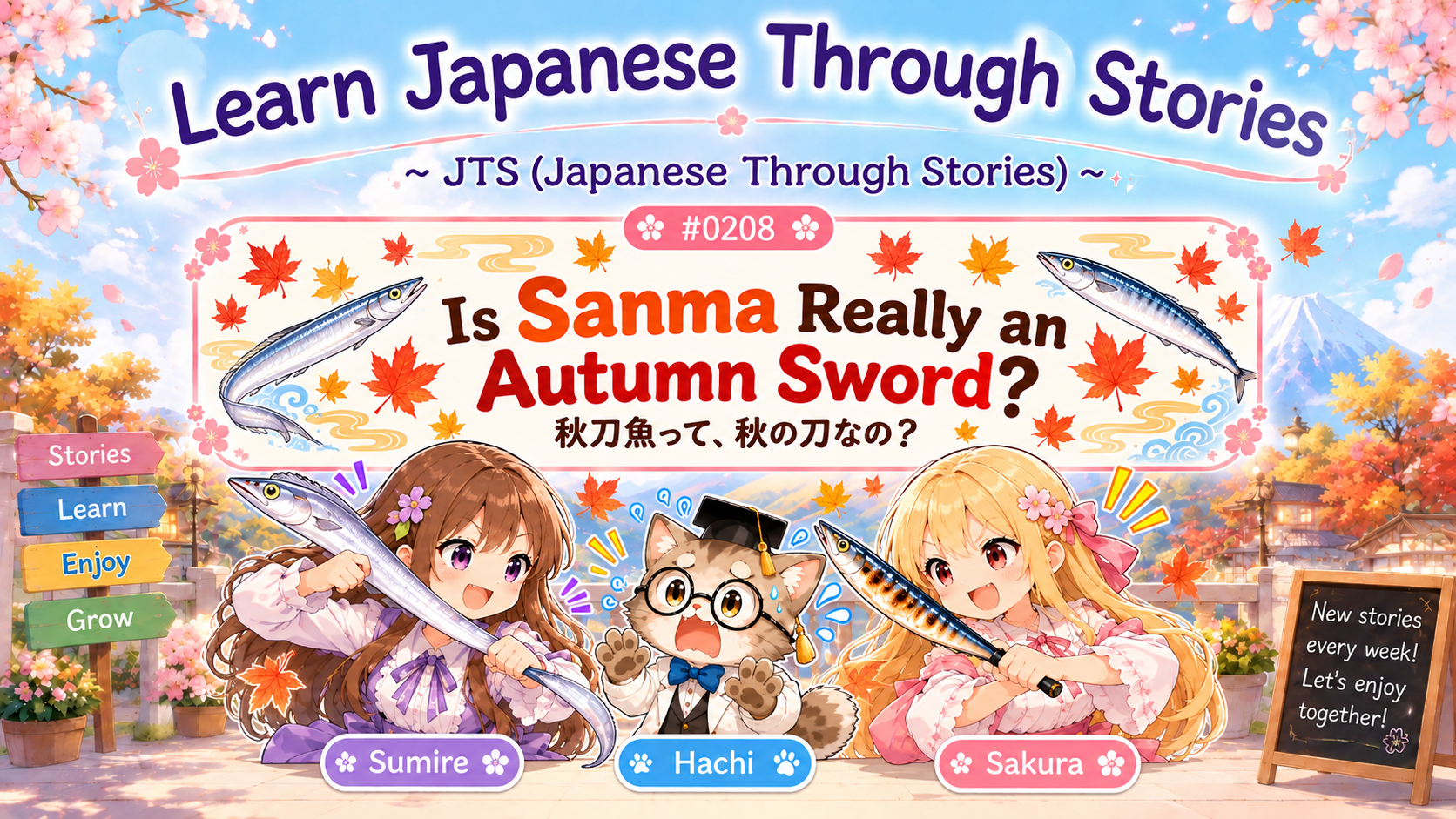
Sakura and Sumire bought some sanma (Pacific saury).
秋刀魚を買った、さくらとすみれ。
Sanma o katta, Sakura to Sumire.

a taste of autumn. 😊
秋刀魚だねー😊
sanma da nē. 😊

Doesn’t this kanji 「刀」
feel a little strange?
この「刀」って漢字、
なんだか違和感ない?
Kono 「刀」 tte kanji,
nandaka iwakan nai?
Sanma is long and thin,
but when you say “sword”…
秋刀魚って細長いけど、
刀って言われると……
Sanma tte hosonagai kedo,
katana tte iwareru to…
look much more like swords, right? ⚔️
よっぽど刀らしいよね⚔️
yoppo do katana rashii yo ne. ⚔️
They’re silver,
thin, and long…
銀色で、
細くて長くて……
Gin’iro de,
hosokute nagakute…
has 「太刀」 in it.
名前まで「太刀」だもん。
namae made 「tachi」 da mon.
use the kanji 「刀」?
なんでなんだろう?
nande nan darō?
They spot Hachi.
ハチ先生を見つける。
Hachi-sensei o mitsukeru.
Perfect timing. 😊
ちょうどいいところに😊
Chōdo ii tokoro ni. 😊

use the kanji for “sword”?
Tachiuo looks
much more like a sword.
なんで「刀」なの?
太刀魚の方が、
よっぽど刀みたいなのに。
nande 「katana」 na no?
Tachiuo no hō ga,
yoppo do katana mitai na no ni.
silver, long, and thin,
so they can remind you of a sword, meow.
It is said that sanma
came to be written with
「秋」, 「刀」, and 「魚」
because it is in season in autumn
and has a sword-like shape, meow.
銀色で細長い姿が
刀を思わせる魚にゃ。
秋刀魚は、
秋に旬を迎えることと、
刀のような姿から、
「秋」「刀」「魚」と
書かれるようになったと
いわれているにゃ。
gin’iro de hosonagai sugata ga
katana o omowaseru sakana nya.
Sanma wa,
aki ni shun o mukaeru koto to,
katana no yō na sugata kara,
「aki」「katana」「sakana」 to
kakareru yō ni natta to
iwarete iru nya.
really does make sense.
ちゃんと刀なんだね。
chanto katana nan da ne.
tachiuo wins by far! ⚔️
並べたら太刀魚の圧勝だよー⚔️
narabetara tachiuo no asshō da yō. ⚔️
to decide their names, meow.
戦ってるわけじゃないにゃ。
tatakatteru wake janai nya.
💭 Story Note
The Japanese word for Pacific saury is 「秋刀魚」 (sanma).
These three kanji are:
「秋」 — autumn
「刀」 — sword
「魚」 — fish
In this story,
Hachi explains that sanma is in season in autumn
and has a long, thin, silver body
that can remind people of a sword.
That is why the name 「秋刀魚」
is connected with both autumn
and the fish’s shape.
Another fish in the story is 「太刀魚」 (tachiuo).
Its name also includes a word connected with a sword:
「太刀」 (tachi), a type of Japanese sword.
Looking at the kanji in fish names
can sometimes show us
how people saw their shape,
season, or appearance.
📚 Vocabulary
Here are some words and expressions from this story.
| English | Japanese | Romaji |
|---|---|---|
| Pacific saury | 秋刀魚 | sanma |
| in season | 旬 | shun |
| sword | 刀 | katana |
| cutlassfish | 太刀魚 | tachiuo |
| a feeling that something is strange | 違和感 | iwakan |
「旬」(shun) means
the time when a food is at its best.
It is often used for
fish, vegetables, fruits,
and other seasonal foods.
For example:
「秋刀魚は秋が旬です。」
Sanma wa aki ga shun desu.
“Pacific saury is in season in autumn.”
「旬の魚を食べる。」
Shun no sakana o taberu.
“We eat fish that is in season.”
「旬」 is useful when talking about
seasonal food in Japan.
🔰 Mix Words and Feel Their Meaning|ことばを混ぜて、感覚をつかもう
Today’s word is 「旬」.
Try mixing it into English:
“Sanma is 旬 in autumn.”
“This fish is 旬 now.”
“We eat 旬 vegetables.”
The goal is not to make perfect Japanese.
Think about the feeling of 「旬」.
It means the best season
for a certain food.
In this story,
sanma is 旬 in autumn.

コメント