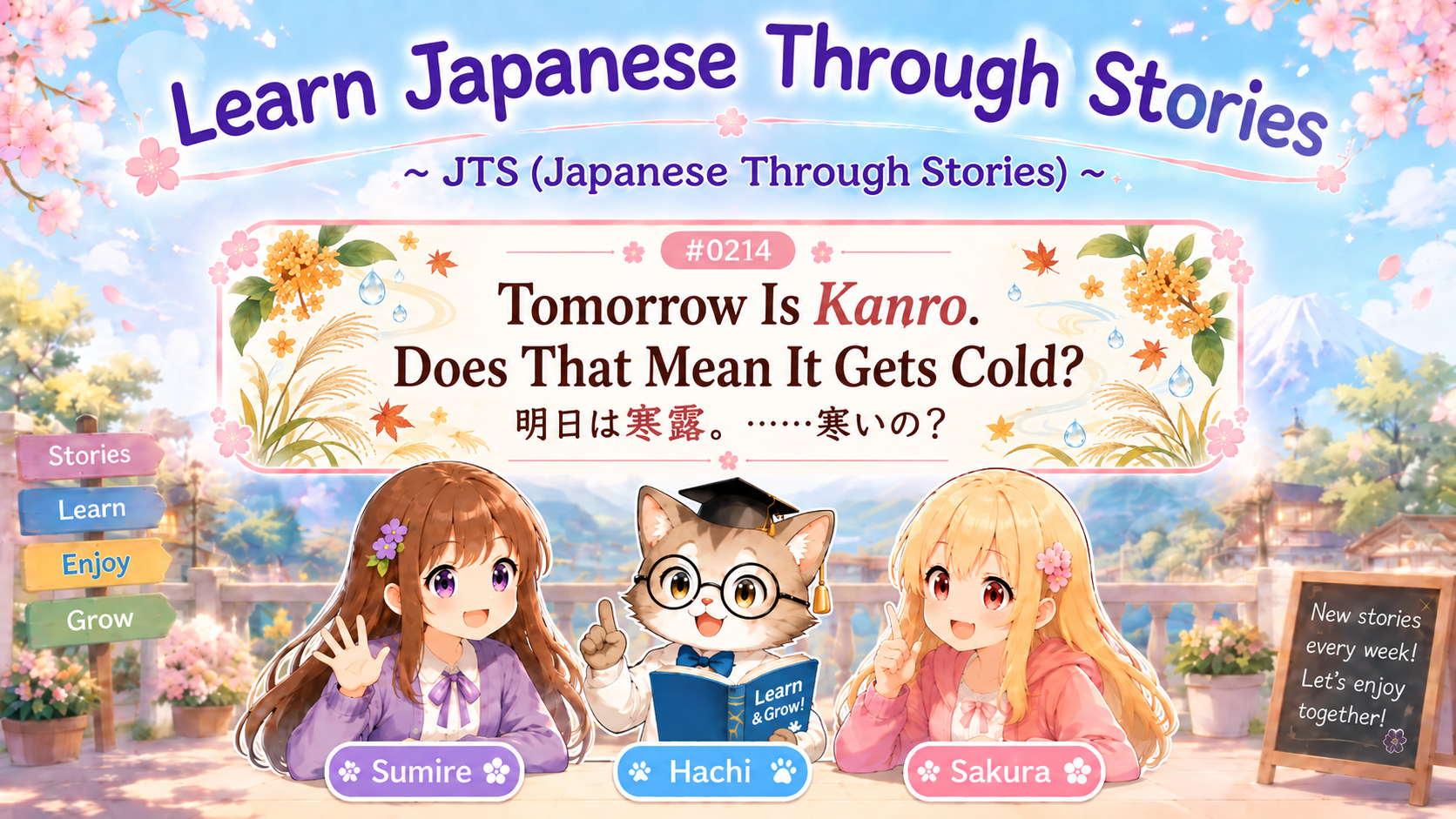
📖 Study Guide
Learn Japanese through stories.
These stories include Japanese culture,
daily life, travel experiences,
and conversations between people.
1. Read the English text.
2. Read the Japanese text.
3. Use Romaji if needed.
4. Review the vocabulary.
🌸 Story
are looking at a calendar.
カレンダーを見ている。
karendā o mite iru.

on tomorrow’s date.
「寒露」って書いてある。
“Kanro” tte kaite aru.

what it means.
どういう意味なんだろう?
dō iu imi nan darō?
it does sound like that.
そんな感じだよね。
sonna kanji da yo ne.
it’ll get cold starting tomorrow? 💦
寒くなるってこと?💦

one of the twenty-four seasonal divisions, nya.
二十四節気のひとつだにゃ。
nijūshi sekki no hitotsu da nya.
when mornings and evenings get cooler,
and even the dew on grass and leaves feels cold, nya.
草や葉につく露にも
冷たさを感じる頃を表しているにゃ。
kusa ya ha ni tsuku tsuyu ni mo
tsumetasa o kanjiru koro o arawashite iru nya.
“It gets cold starting tomorrow!”
っていう意味じゃないんだ。
tte iu imi ja nai n da.
as the season moves
from autumn toward winter, nya.
秋から冬へ向かっている、
そんな変化を表す言葉なんだにゃ。
aki kara fuyu e mukatte iru,
sonna henka o arawasu kotoba nan da nya.
really noticed
the little changes in the seasons.
季節の小さな変化を
ちゃんと見てたんだね。
kisetsu no chiisana henka o
chanto miteta n da ne.
shows us how the season is changing along the way. 😊
季節の途中経過が書いてあるみたい😊
kisetsu no tochū keika ga kaite aru mitai. 😊
💭 Story Note
In Japan,
the traditional calendar includes
twenty-four seasonal divisions
called 「二十四節気」(nijūshi sekki).
The year is divided into
twenty-four parts,
each with a name that describes
a small change in the season.
「寒露」(Kanro)
is one of these seasonal divisions.
These words do not mean
that the weather suddenly changes
on one specific day.
Instead,
they mark the gradual movement
of the seasons.
That is why words like Kanro
can still appear
on Japanese calendars today,
even though people may not use them
very often in everyday conversation.
📚 Vocabulary
Here are some words and expressions from this story.
| English | Japanese | Romaji |
|---|---|---|
| Kanro | 寒露 | kanro |
| twenty-four seasonal divisions | 二十四節気 | nijūshi sekki |
| dew | 露 | tsuyu |
| does that mean…? | ってこと? | tte koto? |
| progress / along the way | 途中経過 | tochū keika |
「ってこと?」(tte koto?)
is a casual expression used
when you want to check
what something means
or confirm what you understood.
It is similar to:
“Does that mean…?”
or
“So you mean…?”
For example:
「明日は休みってこと?」
Ashita wa yasumi tte koto?
“Does that mean tomorrow is a day off?”
「もう終わりってこと?」
Mō owari tte koto?
“Does that mean it’s already over?”
In this story,
Sakura says:
「寒くなるってこと?」
She is checking whether
seeing 「寒露」 on the calendar means
that it will start getting cold.
「ってこと?」 is very common
in casual conversation
with friends and family.
🔰 Mix Words and Feel Their Meaning|ことばを混ぜて、感覚をつかもう
「ってこと?」(tte koto?)
is useful when you want to check
what something means
or confirm what you understood.
Try mixing it into English:
“Tomorrow is a day off ってこと?”
“It’s already finished ってこと?”
“So this means it will get cold ってこと?”
The sentences are intentionally mixed.
The goal is not
to make perfect Japanese.
It is to feel how 「ってこと?」
works when you want to say,
“Does that mean…?”
コメント