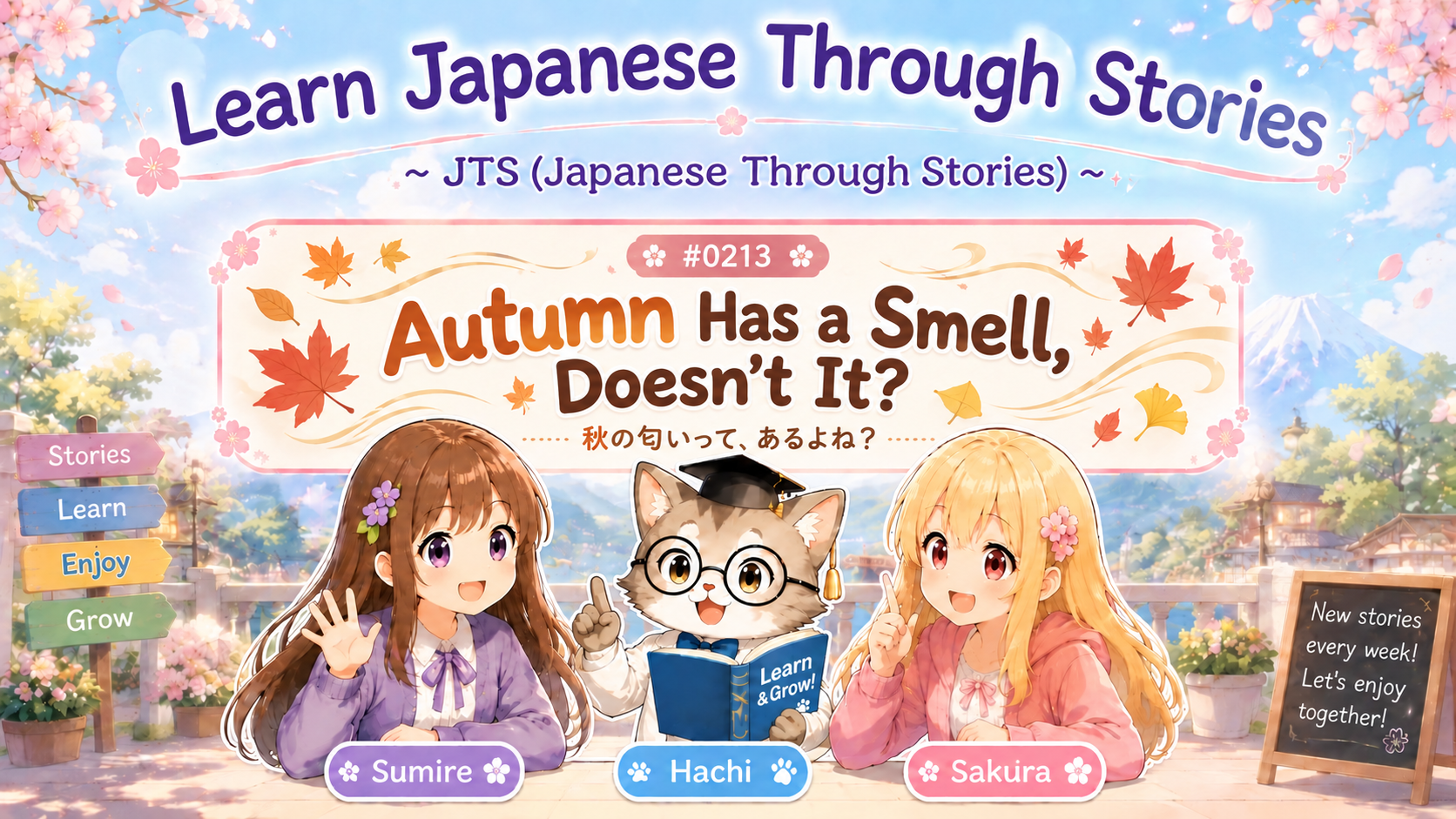
📖 Study Guide
Learn Japanese through stories.
These stories include Japanese culture,
daily life, travel experiences,
and conversations between people.
1. Read the English text.
2. Read the Japanese text.
3. Use Romaji if needed.
4. Review the vocabulary.
🌸 Story
are walking outside.
さくらとすみれ。
Sakura to Sumire.

Autumn has
a smell, doesn’t it?
秋の匂いって、
あるよね?
Aki no nioi tte,
aru yo ne?

if someone asks,
“What does it smell like?”
I can’t really explain it. 💦
どんな匂い?って聞かれると、
説明できないんだよね💦
Donna nioi? tte kikareru to,
setsumei dekinai n da yo ne. 💦
That’s true. 🤣
たしかに🤣
Tashika ni. 🤣
sweet osmanthus,
where you can say,
“That’s the smell!”
It’s more like…
the air just
feels autumn-like.
「これ!」っていう匂いじゃなくて……
なんとなく、
空気が秋っぽいの。
“kore!” tte iu nioi janakute…
Nantonaku,
kūki ga aki ppoi no.
getting a little cooler,
or the smell
of fallen leaves?
落ち葉の匂いとか?
ochiba no nioi toka?
And
the wind feels different too.
あと、
風の感じも違うよね。
Ato,
kaze no kanji mo chigau yo ne.
change too,
and the color of the sky
slowly starts to change.
空の色も、
少しずつ変わってくるね。
sora no iro mo,
sukoshi zutsu kawatte kuru ne.
when you think about it,
we don’t feel autumn
only with our eyes.
そう考えると、
秋って、
目だけで感じてるんじゃないんだね。
Sō kangaeru to,
aki tte,
me dake de kanjiteru n janai n da ne.
Through smells,
sounds,
and the air we feel on our skin.
Autumn comes to us
in so many different ways. 😊
匂いとか、
音とか、
肌で感じる空気とか。
いろんなところから、
秋がやってくるんだね😊
Nioi toka,
oto toka,
hada de kanjiru kūki toka.
Ironna tokoro kara,
aki ga yatte kuru n da ne. 😊
Then…
what about autumn
you can taste?
じゃあ……
味で感じる秋は?
Jā…
aji de kanjiru aki wa?
that might be
the first one you notice. 🤣
そこが一番早そうだけどね🤣
soko ga ichiban hayasa sō dakedo ne. 🤣
💭 Story Note
In Japan,
people often talk about
“feeling the season” in everyday life.
This does not always mean
seeing something clearly seasonal.
Sometimes,
a change in the air,
the sound of insects,
the smell of fallen leaves,
or the feeling of wind on the skin
can make people notice
that the season is changing.
Autumn, in particular,
is often described through
many different senses.
You may see different colors,
hear different sounds,
feel cooler air,
or notice new smells.
In this story,
Sakura and Sumire talk about autumn
as something that arrives
little by little,
through many small changes.
📚 Vocabulary
Here are some words and expressions from this story.
| English | Japanese | Romaji |
|---|---|---|
| smell | 匂い | nioi |
| autumn-like | 秋っぽい | aki-ppoi |
| fallen leaves | 落ち葉 | ochiba |
| to feel | 感じる | kanjiru |
| to come / arrive | やってくる | yatte kuru |
「秋っぽい」(aki-ppoi)
means “autumn-like” or “feels like autumn.”
The ending 「〜っぽい」 (-ppoi)
is often added to a word
when something has the feeling,
look, or quality of that thing.
For example:
「今日は秋っぽいね。」
Kyō wa aki-ppoi ne.
“It feels autumn-like today.”
「この色、秋っぽい。」
Kono iro, aki-ppoi.
“This color feels autumn-like.”
In this story,
Sakura says:
「空気が秋っぽいの。」
Kūki ga aki-ppoi no.
“The air feels autumn-like.”
She is not talking about
one specific smell or sound.
She means that
the whole atmosphere somehow
feels like autumn.
🔰 Mix Words and Feel Their Meaning|ことばを混ぜて、感覚をつかもう
Today’s expression is 「秋っぽい」.
Try mixing it into English:
“The air feels 秋っぽい today.”
“This wind is a little 秋っぽい.”
“The color of the sky is becoming 秋っぽい.”
The goal is not to make perfect Japanese.
Think about the feeling of 「秋っぽい」.
It does not mean
that something is completely autumn.
It means that
something has an autumn-like feeling.
A smell,
a color,
the wind,
or the air
can make you feel
that autumn is getting closer.
In this story,
Sakura feels that
the air is 「秋っぽい」.
コメント