📖 Study Guide
Learn Japanese through stories.
These stories include Japanese culture,
daily life, travel experiences,
and conversations between people.
1. Read the English text.
2. Read the Japanese text.
3. Use Romaji if needed.
4. Review the vocabulary.
🌸 Story
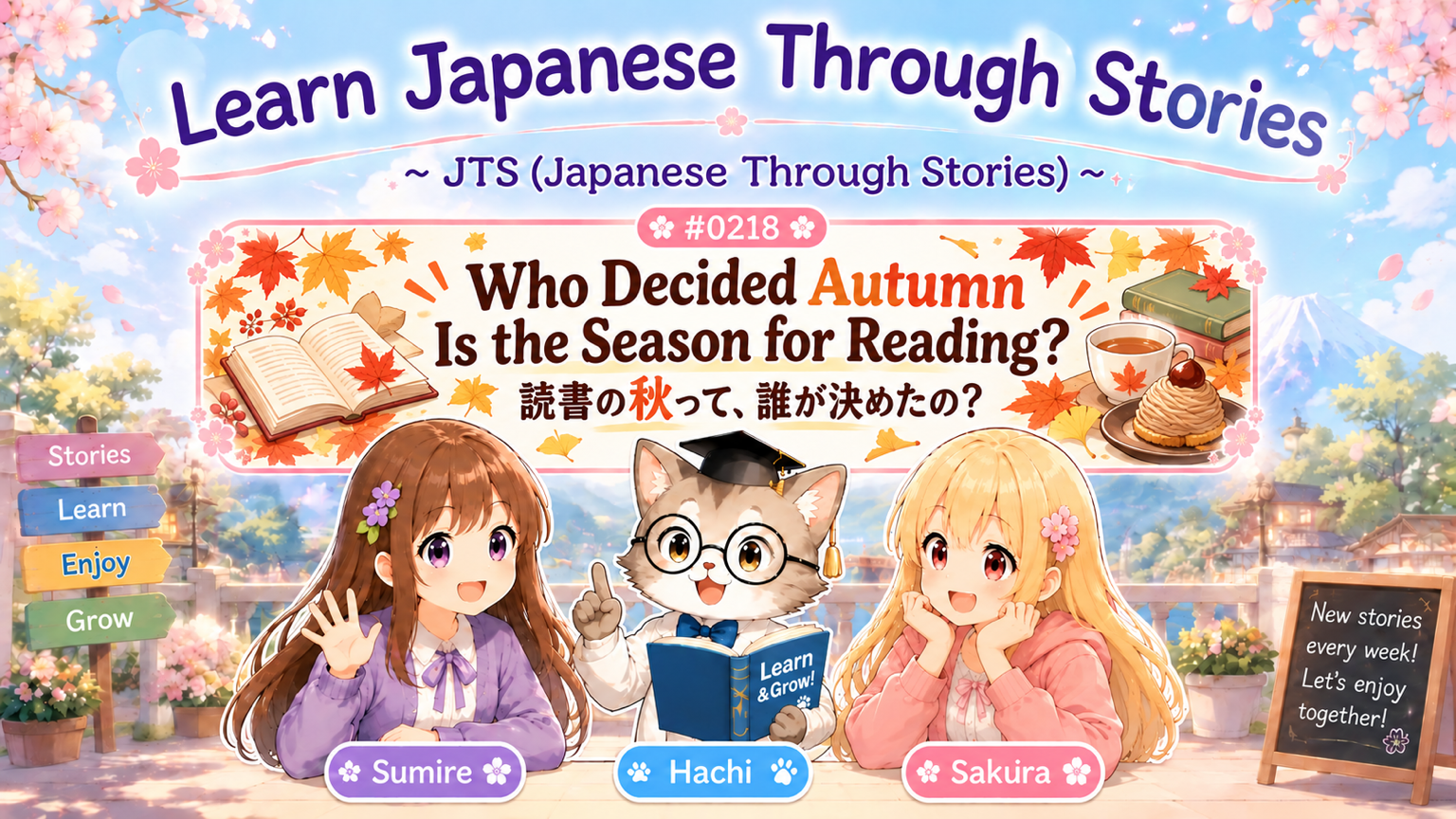
Sakura and Sumire are talking while looking at a book.
さくらとすみれが、本を見ながら話している。
Sakura to Sumire ga, hon o minagara hanashite iru.

You know how people say
“autumn is the season for reading”?
「読書の秋」って
言うじゃない?
“Dokusho no aki” tte
iu janai?

誰が決めたの?
Dare ga kimeta no?
you can read books
in spring, summer, or winter too,
right?
本なんて
春でも夏でも冬でも
読めるでしょ?
hon nante
haru demo natsu demo fuyu demo
yomeru desho?
as soon as autumn comes,
it’s suddenly like,
“Okay.
Time to read!”
秋になると急に
「はい。
読書してくださいー」
みたいになるじゃない。
aki ni naru to kyū ni
“Hai.
Dokusho shite kudasai.”
mitai ni naru janai.
like that, though. 🤣
してないけどね🤣
shitenai kedo ne. 🤣
autumn for reading,
autumn for appetite,
autumn for sports…
doesn’t autumn
have a lot of jobs?
読書の秋とか、
食欲の秋とか、
スポーツの秋とか……
秋って、
担当多くない?
dokusho no aki toka,
shokuyoku no aki toka,
supōtsu no aki toka…
aki tte,
tantō ōkunai?
Autumn
is busy.
秋、
忙しいね。
Aki,
isogashii ne.
it’s not too hot,
and not too cold,
so maybe
it’s just the right season
for reading.
暑すぎなくて、
寒すぎなくて、
本を読むには
ちょうどいい季節なのかもね。
atsusuginakute,
samusuginakute,
hon o yomu ni wa
chōdo ii kisetsu na no kamo ne.
That kind of
makes sense.
それなら
ちょっと分かるかも。
Sore nara
chotto wakaru kamo.
Sakura,
what are you reading?
さくらは
何を読んでるの?
Sakura wa
nani o yonderu no?
A special feature
on autumn sweets.
秋のスイーツ特集。
Aki no suītsu tokushū.
Isn’t that
“autumn for appetite”? 🤣
それ、
食欲の秋じゃない?🤣
Sore,
shokuyoku no aki janai? 🤣
💭 Story Note
In Japan, autumn is often connected with different activities and pleasures.
You may hear expressions such as:
“読書の秋” (dokusho no aki) — autumn for reading
“食欲の秋” (shokuyoku no aki) — autumn for appetite
“スポーツの秋” (supōtsu no aki) — autumn for sports
The pattern “___の秋” is a familiar way to connect autumn with something people enjoy doing during the season.
In this story, Sumire suggests one simple reason for “読書の秋”:
autumn is not too hot and not too cold, so it can feel like a comfortable season for reading.
Of course, Sakura somehow ends up connecting reading with autumn sweets too. 💦
📚 Vocabulary
Here are some words and expressions from this story.
| English | Japanese | Romaji |
|---|---|---|
| reading | 読書 | dokusho |
| decided | 決めた | kimeta |
| appetite | 食欲 | shokuyoku |
| just right | ちょうどいい | chōdo ii |
| special feature | 特集 | tokushū |
「決めた」(kimeta)
means “decided.”
It is the past form of
「決める」(kimeru),
which means “to decide.”
For example:
「私が決めた。」
Watashi ga kimeta.
“I decided.”
「誰が決めたの?」
Dare ga kimeta no?
“Who decided that?”
In casual conversation,
the ending 「の?」 can make
a question sound natural
when asking for an explanation.
In this story,
Sakura asks:
「誰が決めたの?」
She wants to know
who decided that autumn
should be called
“the season for reading.”
🔰 Mix Words and Feel Their Meaning|ことばを混ぜて、感覚をつかもう
Today’s expression is 「決めた」.
Try mixing it into English:
“I looked at the menu and 決めた — this one!”
“We talked about where to go and finally 決めた.”
“I wasn’t sure at first, but I 決めた.”
「決めた」 is the past form of
「決める」.
You can use it when
you make a decision,
or when you choose one thing
from several options.
So when you look at a menu
and think,
“This one!”
you can say:
「これに決めた!」
コメント