📖 Study Guide
Learn Japanese through stories.
These stories include Japanese culture,
daily life, travel experiences,
and conversations between people.
1. Read the English text.
2. Read the Japanese text.
3. Use Romaji if needed.
4. Review the vocabulary.
🌸 Story
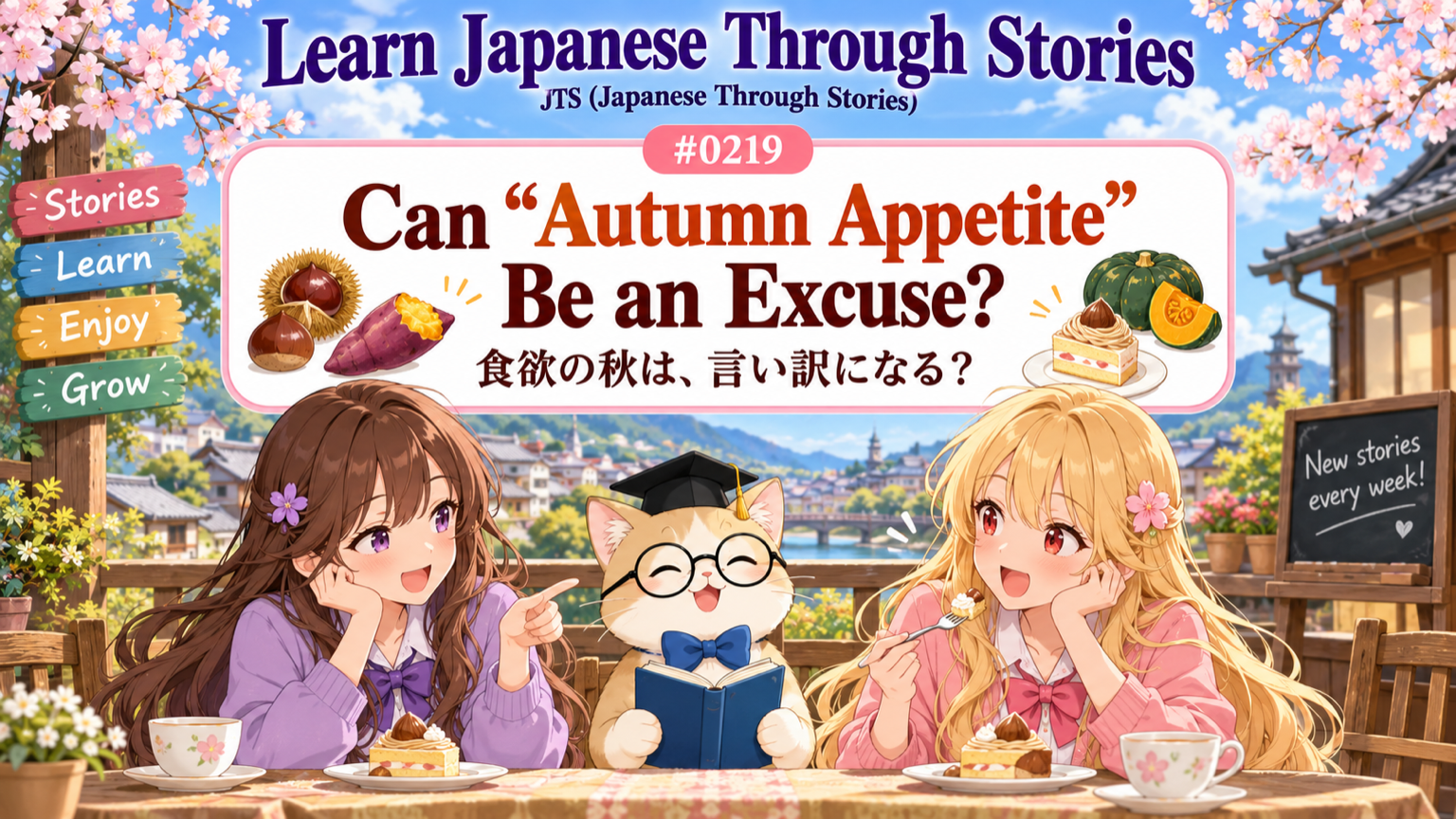
Sakura and Sumire are talking with some snacks in front of them.
さくらとすみれが、おやつを前に話している。
Sakura to Sumire ga, oyatsu o mae ni hanashite iru.

people say “autumn is the season for appetite,” right?
言うじゃない?
iu janai?

it’s okay to eat
a lot?
いっぱい食べてもいいって
ことなのかな?
ippai tabete mo ii tte
koto na no kana?
get to that? 🤣
そうなるの?🤣
sō naru no? 🤣
it’s “autumn for appetite,” right?
食欲の秋でしょ?
shokuyoku no aki desho?
if I eat a little more
than usual in autumn……
it’s the season’s fault.
秋はいつもより
ちょっと多く食べても……
季節のせい。
aki wa itsumo yori
chotto ōku tabete mo……
kisetsu no sei.
on the season. 🤣
chestnuts,
sweet potatoes,
pumpkin……
Autumn has
so many delicious foods.
栗とか、
さつまいもとか、
かぼちゃとか……
秋って、
おいしいもの多いじゃない。
kuri toka,
satsumaimo toka,
kabocha toka……
aki tte,
oishii mono ōi janai.
So,
if I eat too much,
it can’t be helped, right?
だから、
食べすぎても
仕方ないよね。
Dakara,
tabesugite mo
shikata nai yo ne.
that’s a different story.
別の話だと思う。
betsu no hanashi da to omou.
Then,
what is
“autumn for appetite” for?
じゃあ、
「食欲の秋」は
何のためにあるの?
Jā,
“shokuyoku no aki” wa
nan no tame ni aru no?
to give you an excuse. 🤣
how many pieces of cake
have you had?
そのケーキ
何個目?
sono kēki
nanko-me?
Dessert
has its own stomach.
これは
別腹。
Kore wa
betsubara.
has nothing to do with it. 🤣
関係なくなったね🤣
kankei nakunatta ne. 🤣
💭 Story Note
In Japan, autumn is often connected with food.
You may hear the expression:
「食欲の秋」(shokuyoku no aki)
It literally means
“autumn of appetite,”
and it is used to describe
the idea that food feels especially enjoyable
during autumn.
Autumn is also a season
when many foods such as chestnuts,
sweet potatoes, and pumpkin
are commonly enjoyed.
Another expression in this story is:
「別腹」(betsubara)
It literally means
“another stomach” or “a separate stomach.”
Japanese people often use it jokingly
when they are already full
but still want to eat dessert.
For example:
「もうお腹いっぱい。でも、デザートは別腹!」
This means something like:
“I’m already full,
but I still have room for dessert!”
Of course,
there is not really another stomach.
It is a playful way of saying
that dessert somehow still feels possible,
even after a full meal.
📚 Vocabulary
| English | Japanese | Romaji |
|---|---|---|
| appetite | 食欲 | shokuyoku |
| excuse | 言い訳 | iiwake |
| it can’t be helped | 仕方ない | shikata nai |
| season | 季節 | kisetsu |
| room for dessert | 別腹 | betsubara |
「別腹」(betsubara)
is a playful Japanese expression
often used when someone is already full
but still wants dessert.
Literally,
「別」 means “separate”
and 「腹」 means “stomach.”
So 「別腹」 literally sounds like
“a separate stomach.”
But in everyday conversation,
it usually means something closer to:
“I still have room for dessert.”
For example:
「デザートは別腹!」
Dezāto wa betsubara!
“I still have room for dessert!”
「お腹いっぱいだけど、ケーキは別腹。」
Onaka ippai dakedo, kēki wa betsubara.
“I’m full, but I still have room for cake.”
「別腹」 is usually said
in a light and playful way.
It does not mean
that someone really has
another stomach.
🔰 Mix Words and Feel Their Meaning|ことばを混ぜて、感覚をつかもう
Today’s expression is 「別腹」.
Try mixing it into English:
“I’m full, but dessert is 別腹!”
“I can’t eat any more dinner,
but cake is 別腹.”
“I said I was full……
then I saw the dessert menu.
別腹!” 🤣
「別腹」 literally sounds like
“a separate stomach.”
But it is usually used
in a playful way.
It means that even when
you are already full,
you somehow still have
room for dessert.
So after a big meal,
if someone offers you cake,
you might say:
「デザートは別腹!」
コメント