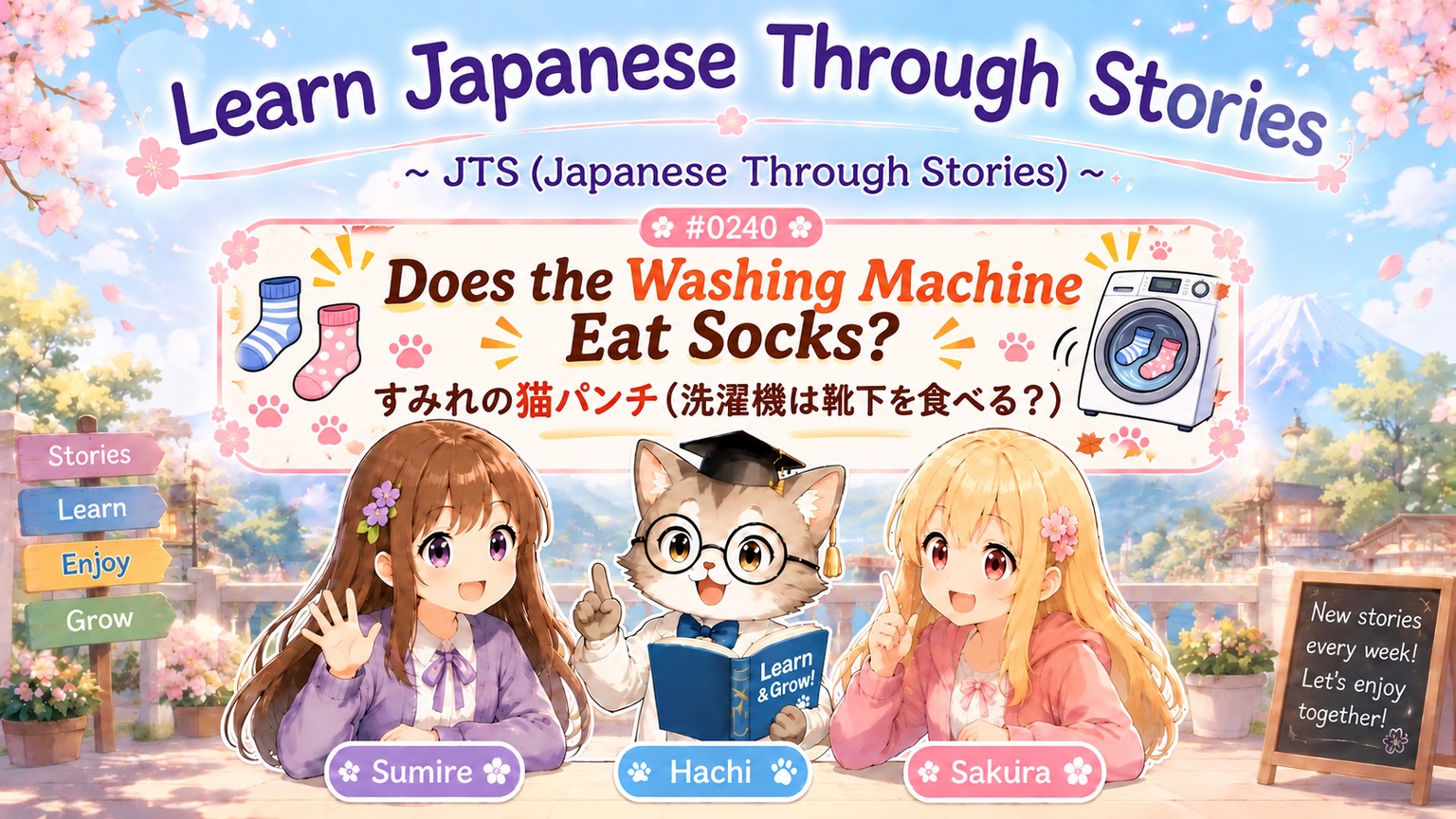
📖 Study Guide
Learn Japanese through stories.
These stories include Japanese culture,
daily life, travel experiences,
and conversations between people.
1. Read the English text.
2. Read the Japanese text.
3. Use Romaji if needed.
4. Review the vocabulary.
🌸 Story
Sakura and Sumire are getting ready to leave
their classroom.
The sky is cloudy outside.
It looks like it might start raining any minute.
さくらとすみれが、
教室で帰り支度をしています。
外は曇り空。
今にも雨が降り出しそうです。
Sakura to Sumire ga,
kyoushitsu de kaerijitaku o shite imasu.
Soto wa kumorizora.
Ima ni mo ame ga furidashisou desu.

Do you think washing machines…
eat socks? 🤔
洗濯機ってさぁ……
靴下、食べるのかな?🤔
Sentakuki tte saa…
Kutsushita, taberu no kana? 🤔

What are you talking about? 🤣
何言ってるの?🤣
Nani itteru no? 🤣
I’m sure I put two socks in,
but only one came out.
二枚入れたはずなのに、
一枚しか出てこないんだもん。
Nimai ireta hazu nanoni,
ichimai shika dete konai n da mon.
It’s true that sometimes
just one sock goes missing.
片方だけなくなること、
確かにあるよね。
Katahou dake nakunaru koto,
tashika ni aru yo ne.
Yesterday, too,
one of my socks disappeared.
昨日もね、
靴下が一枚なくなったの。
Kinou mo ne,
kutsushita ga ichimai nakunatta no.
the laundry basket and everything?
ちゃんと確認した?
chanto kakunin shita?
I even checked inside the washing machine.
洗濯機の中も見たよ。
Sentakuki no naka mo mita yo.
It was raining,
so I dried the laundry at a laundromat.
雨だったから、
コインランドリーで乾かしたのよ。
Ame datta kara,
koin randorii de kawakashita no yo.
Maybe you left it in the dryer!
乾燥機に忘れてきたんじゃない?
Kansouki ni wasurete kita n janai?
But it wasn’t there.
なかったの。
Nakatta no.
Then where on earth did it go?
じゃあ、本当にどこへ?
Jaa, hontou ni doko e?
The washing machine ate it! 😤
洗濯機が食べちゃったんだよ!😤
Sentakuki ga tabechatta n da yo! 😤
I found it a little while ago.
さっき見つかったの。
Sakki mitsukatta no.
Where was it?
どこにあったの?
Doko ni atta no?
Then it was there all along! 🤣
最初からそこにあったんじゃない!🤣
Saisho kara soko ni atta n janai! 🤣
Then the washing machine was innocent! 😊
じゃあ、洗濯機は無実だったんだ!😊
Jaa, sentakuki wa mujitsu datta n da! 😊
I almost blamed
the washing machine!
危うく洗濯機を
犯人にするところだったよ!
Ayauku sentakuki o
hannin ni suru tokoro datta yo!
Sorry, Mr. Washing Machine.
I shouldn’t have suspected you! 😊
洗濯機さん、ごめんね。
疑って悪かったよー!😊
Sentakuki-san, gomen ne.
Utagatte warukatta yoo! 😊
Before apologizing to the washing machine,
make sure you look properly! 🤣
洗濯機に謝る前に、
ちゃんと探しなさーい!🤣
Sentakuki ni ayamaru mae ni,
chanto sagashinasai! 🤣
and gets ready to pounce at Sakura.
さくらに向かって構えます。
Sakura ni mukatte kamaemasu.
💭 Story Note
### 🧺 Using a Coin Laundry in Japan
In Japan, a self-service laundromat is often called
コインランドリー (koin randorii).
The name comes from the English words
“coin” and “laundry.”
People use coin laundries for washing clothes,
drying clothes, or both.
For example, on rainy days,
some people wash their clothes at home
and use a laundromat only for drying.
This is what Sakura does in the story.
Although the Japanese name includes “coin,”
some modern laundromats also accept
cashless payments.
### 🧦 Looking for Something You’ve Lost
In everyday Japanese conversation,
people sometimes talk about missing things
as if they have disappeared mysteriously.
For example:
「靴下が一枚なくなった。」
Kutsushita ga ichimai nakunatta.
“One of my socks went missing.”
This doesn’t necessarily mean
someone took the sock.
It simply means the sock is no longer
where the speaker expected it to be.
When Sakura says the washing machine
must have eaten her sock,
she is jokingly treating it
like a person who could be responsible.
### 😊 Talking to Things as If They Were People
Near the end of the story,
Sakura says:
「洗濯機さん、ごめんね。」
Sentakuki-san, gomen ne.
“Sorry, Mr. Washing Machine.”
The suffix さん (san) is usually attached
to people’s names as a polite form of address.
But it can also be added playfully
to the names of animals or objects,
making them sound more like people.
Here, Sakura calls the washing machine
「洗濯機さん」 (sentakuki-san)
and apologizes to it.
This makes the scene sound
gentle, playful, and a little silly.
And that’s when Sumire
finally gives her famous Cat Punch! 🐾
📚 Vocabulary
EN: washing machine
JP: 洗濯機
ROMAJI: sentakuki
EN: laundromat / self-service laundry
JP: コインランドリー
ROMAJI: koin randorii
EN: innocent / not guilty
JP: 無実
ROMAJI: mujitsu
EN: Mr. / Ms. / an affectionate or polite name suffix
JP: さん
ROMAJI: san
🌱 Language Tip — さん (san)
In Japanese, さん (san) is a suffix
often added after someone’s name.
It is a polite and friendly way
to address or refer to a person.
For example:
「すみれさん、こんにちは。」
Sumire-san, konnichiwa.
“Hello, Sumire.”
But さん can also be used playfully
with animals, objects, and even things
that are not alive.
In the story, Sakura says:
「洗濯機さん、ごめんね。」
Sentakuki-san, gomen ne.
“Sorry, Mr. Washing Machine.”
Here, Sakura is not really treating
the washing machine as a person.
She is jokingly speaking to it
as if it had feelings.
Adding さん makes the washing machine
sound like someone she can apologize to.
This playful use can make a sentence
sound cute, gentle, or funny.
For example:
「お月さん、こんばんは。」
Otsuki-san, konbanwa.
“Good evening, Mr. Moon.”
In everyday Japanese,
さん is mainly used with people’s names.
Using it with objects is not a general rule.
It depends on the situation, the speaker,
and the feeling they want to express.
In Sakura’s case,
「洗濯機さん」 makes her apology
even funnier and more charming.
🔰 Mix Words and Feel Their Meaning|ことばを混ぜて、感覚をつかもう
In Japanese, さん (san) is commonly added
to a person’s name to show politeness or respect.
But sometimes, it can also make an object
sound like a person.
For example…
Good morning, Tanakaさん!
I’m sorry, washing machineさん.
I shouldn’t have blamed you! 😊
Good evening, moonさん.
You look beautiful tonight.
When さん is added to a person’s name,
it usually sounds polite and respectful.
When it is added playfully to an object,
it can make the object sound friendly
or almost human.
That’s the gentle, playful feeling
behind Sakura’s 「洗濯機さん」.


コメント