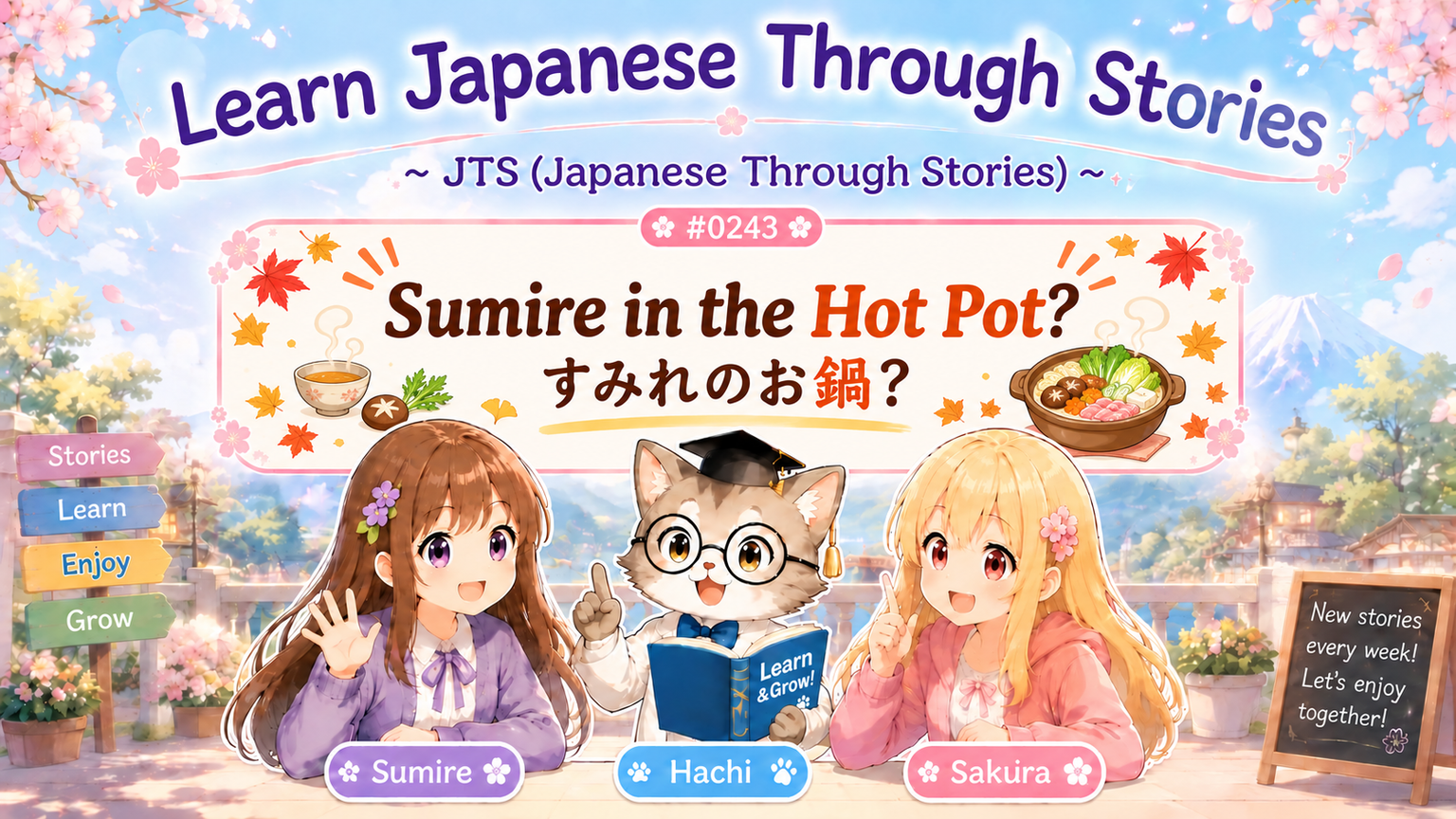
📖 Study Guide
Learn Japanese through stories.
These stories include Japanese culture,
daily life, travel experiences,
and conversations between people.
1. Read the English text.
2. Read the Japanese text.
3. Use Romaji if needed.
4. Review the vocabulary.
🌸 Story
Sakura and Sumire are looking at the hot pot soup bases at the supermarket.
さくらとすみれが、スーパーの鍋つゆコーナーを眺めている。
Sakura to Sumire ga, suupaa no nabetsuyu koonaa o nagamete iru.

It’s hot pot season! 😆
お鍋の季節だねー!😆
Onabe no kisetsu da nee! 😆

There are so many kinds of hot pot soup bases, too. ☺️
鍋つゆも、いろんな種類があるね。☺️
Nabetsuyu mo, ironna shurui ga aru ne. ☺️
But I was surprised when you bought a whole Chinese cabbage.
でも、白菜を丸ごと買ったときはびっくりしたよ。
Demo, hakusai o marugoto katta toki wa bikkuri shita yo.
and I wanted to make kimchi, too! 😆
キムチも漬けたかったんだもん!😆
kimuchi mo tsuketakatta n da mon! 😆
We were having kimchi hot pot,
and you even made your own kimchi! 🤣
キムチ鍋なのに、
キムチまで作っちゃったもんね。🤣
Kimuchi nabe na noni,
kimuchi made tsukucchatta mon ne. 🤣
That reminds me! Look at this!
そういえば、これ!
Sou ieba, kore!
From that ramen shop in Hokkaido!
北海道のラーメン屋さんのね!
Hokkaidou no raamen’ya-san no ne!
I can’t wait to have Sumire hot pot! 😆
すみれのお鍋、楽しみだなぁ!😆
Sumire no onabe, tanoshimi da naa! 😆
Don’t make it sound like I’m the one going into the pot! 🤣
わたしが煮込まれるみたいに言わないでよー!🤣
Watashi ga nikomareru mitai ni iwanaide yoo! 🤣
💭 Story Note
### 🍲 Hot Pot Season in Japan
In Japan, hot pot dishes are especially popular during the colder months.
This style of cooking is called “nabe” (鍋), which means “pot” in Japanese.
People cook vegetables, meat, seafood, tofu, and other ingredients together in a pot.
Family and friends often gather around the same pot and enjoy the meal together.
It’s warm, comforting, and a lovely way to share a meal.
### 🥬 So Many Kinds of Hot Pot Soup!
Japanese supermarkets sell many kinds of ready-made hot pot soup bases, called “nabetsuyu” (鍋つゆ).
There are soy sauce, miso, kimchi, and many other flavors.
You can choose your favorite soup base, add fresh ingredients, and cook everything together.
It’s a convenient way to prepare a delicious meal without making the soup from scratch.
Chinese cabbage, called “hakusai” (白菜), is a popular ingredient in Japanese hot pot dishes.
### 🍜 A Ramen Shop’s Flavor in a Hot Pot
Some hot pot soup bases are inspired by famous Japanese restaurants.
In this story, Sakura finds one from “Sumire,” a ramen shop from Hokkaido known for its miso ramen.
The name is also “Sumire,” just like Sakura’s twin sister!
That’s what makes their little conversation so funny.
📚 Vocabulary
Let’s learn some Japanese words and expressions from today’s story about hot pot!
| English | Japanese | Romaji |
|---|---|---|
| hot pot soup base | 鍋つゆ | nabetsuyu |
| Chinese cabbage | 白菜 | hakusai |
| whole / entirely | 丸ごと | marugoto |
| wanted to pickle | 漬けたかった | tsuketakatta |
| to be simmered | 煮込まれる | nikomareru |
In Japanese, “marugoto” (丸ごと) means “whole” or “entirely.”
It describes something that is kept or used as one whole thing, without cutting it into smaller parts or leaving anything out.
In today’s story, Sakura bought a whole Chinese cabbage.
Sumire was surprised because Sakura bought the entire cabbage, not just a few leaves!
You can use “marugoto” with many everyday things, such as fruit, vegetables, or even an entire book.
For example:
「りんごを丸ごと食べた。」
Ringo o marugoto tabeta.
I ate a whole apple.
「この本を丸ごと読んだ。」
Kono hon o marugoto yonda.
I read the entire book.
“Marugoto” is a useful expression when you want to emphasize that you mean the whole thing!
🔰 Mix Words and Feel Their Meaning|ことばを混ぜて、感覚をつかもう
Today’s Japanese expression is “丸ごと” (marugoto).
It means “whole” or “entirely”—not just a small part!
① Sakura bought a 丸ごと cabbage! 🥬
② I ate the apple 丸ごと!
③ I read the book 丸ごと!
You don’t have to make a perfect sentence in one language.
Just feel the meaning of “the whole thing” through these little examples. 🌷


コメント