📖 Study Guide
Learn Japanese through stories.
These stories include Japanese culture,
daily life, travel experiences,
and conversations between people.
1. Read the English text.
2. Read the Japanese text.
3. Use Romaji if needed.
4. Review the vocabulary.
🌸 Story
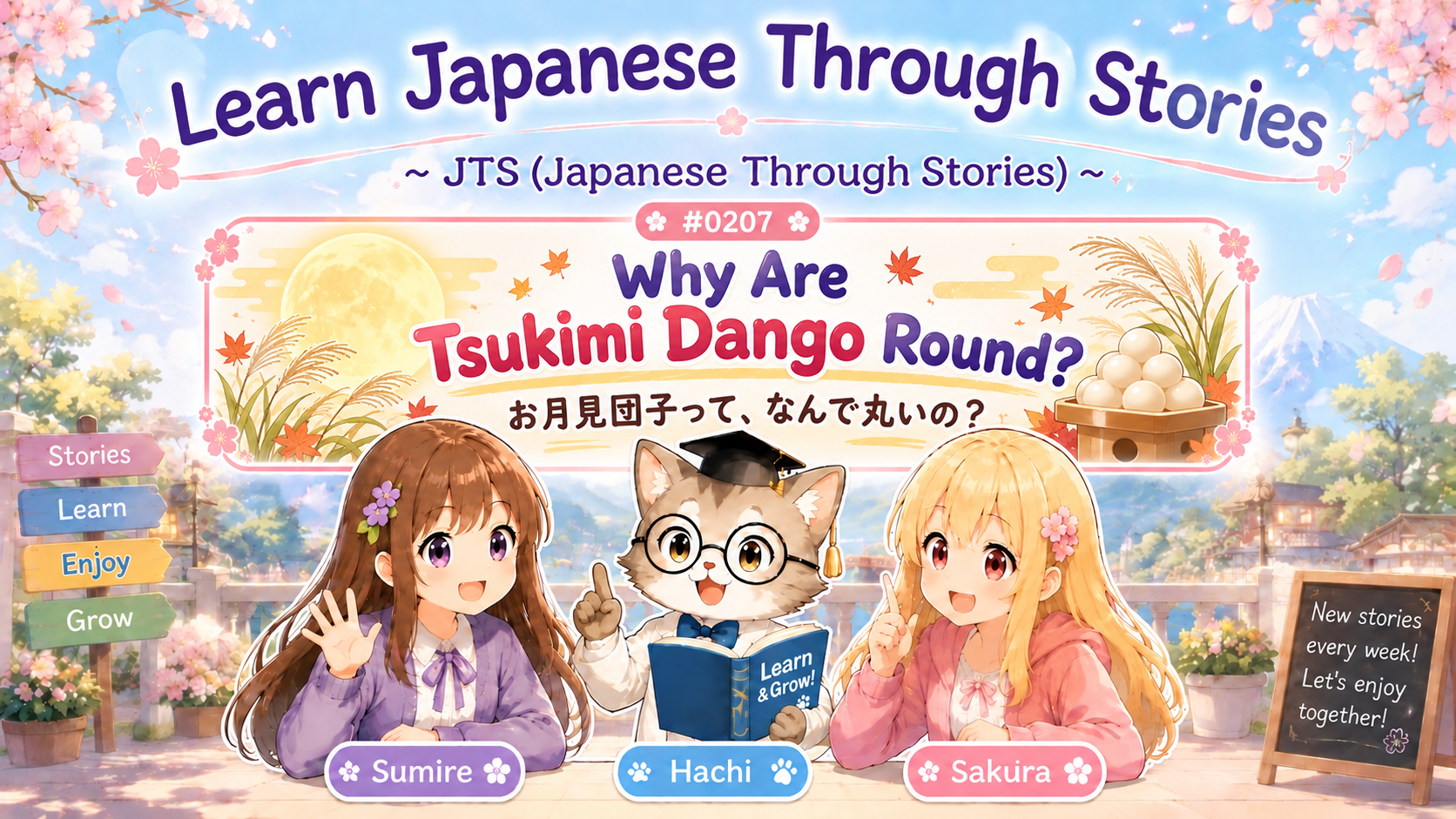
Sakura is looking at the leftover dango.
残っていたお団子を見ている、さくら。
Nokotte ita odango o mite iru, Sakura.

round?
なんで丸いんだろう?
nande marui n darō?

They’re all round, right?
みんな丸いでしょ。
Minna marui desho.
and you only just noticed? 💦
今気づいたの?💦
ima kizuita no? 💦
I just thought they were regular dango.
普通にお団子だと思ってたんだもん。
futsū ni odango da to omotteta n da mon.
are made round to represent the moon.
月に見立てて丸くするんだって。
tsuki ni mitatete maruku suru n datte.
they’re little moons. 🌕
小さなお月さまなんだ🌕
chiisana otsuki-sama nan da. 🌕
They are offered
to show gratitude to the moon
and for the autumn harvest.
月への感謝や、
秋の実りへの感謝を込めて
お供えするんだって。
Tsuki e no kansha ya,
aki no minori e no kansha o komete
osonae suru n datte.
So that’s why
we have dango while enjoying moon viewing.
だから、
お月見しながらお団子なんだね。
Dakara,
otsukimi shinagara odango nan da ne.
Can I eat
this little moon?
この小さなお月さま、
食べてもいい?
Kono chiisana otsuki-sama,
tabete mo ii?
it’s always about eating for you.
そこなのね。
soko na no ne.
💭 Story Note
Tsukimi dango are often made round
to represent the moon.
In this story,
Sumire explains that the round shape
is connected with Jūgoya
and with the image of the moon.
The dango are also offered
with feelings of gratitude.
They can express thanks to the moon
and gratitude for the autumn harvest.
So tsukimi dango are not only food.
Their shape
and the act of offering them
can also carry a seasonal meaning.
For Sakura,
this changes the way she looks at
an ordinary round dango.
It becomes
a small moon on the table.
📚 Vocabulary
Here are some words and expressions from this story.
| English | Japanese | Romaji |
|---|---|---|
| round | 丸い | marui |
| to represent | 見立てる | mitateru |
| gratitude | 感謝 | kansha |
| harvest | 実り | minori |
| to make an offering | お供えする | osonae suru |
「お供えする」(osonae suru) means
to offer something with respect.
In this story,
tsukimi dango are offered
with feelings of gratitude
to the moon and for the autumn harvest.
For example:
「お団子をお供えする。」
Odango o osonae suru.
“We offer dango.”
「感謝を込めてお供えする。」
Kansha o komete osonae suru.
“We make an offering with gratitude.”
「お供えする」 is often used
when food or another item is placed
as an offering with respect.
🔰 Mix Words and Feel Their Meaning|ことばを混ぜて、感覚をつかもう
Today’s word is 「お供えする」.
Try mixing it into English:
“We お供えする dango.”
“We お供えする them with gratitude.”
“People お供えする dango to the moon.”
The goal is not to make perfect Japanese.
Think about the feeling of 「お供えする」.
It means giving or placing something
with respect or gratitude.
In this story,
the dango are お供えする
with thanks to the moon
and for the autumn harvest.
コメント