📖 Study Guide
Learn Japanese through stories.
These stories include Japanese culture,
daily life, travel experiences,
and conversations between people.
1. Read the English text.
2. Read the Japanese text.
3. Use Romaji if needed.
4. Review the vocabulary.
🌸 Story
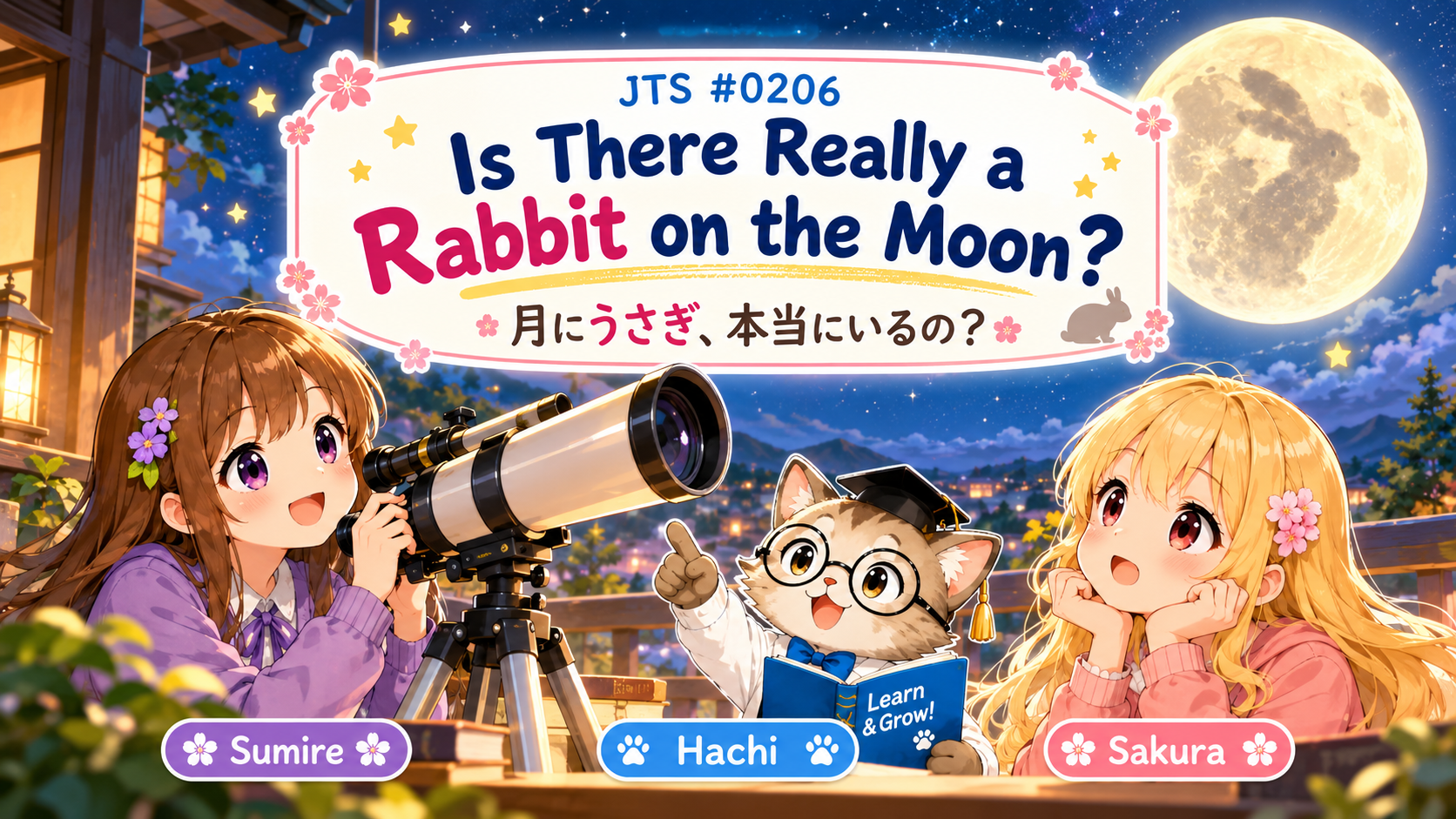
are talking about yesterday’s moon viewing.
さくらとすみれ。
Sakura to Sumire.

yesterday, wasn’t it?
きれいだったね。
kirei datta ne.

While I was looking at the moon,
I remembered that stargazing event
we went to a long time ago.
月を見てたら、
昔行った天体観測のこと
思い出しちゃった。
Tsuki o mitetara,
mukashi itta tentai kansoku no koto
omoidashichatta.
The one they held nearby?
近所でやってたやつ?
Kinjo de yatteta yatsu?
They let us look at the moon
through a big telescope.
大きな望遠鏡で
月を見せてもらったよね。
Ōkina bōenkyō de
tsuki o misete moratta yo ne.
We could see
the craters really clearly.
クレーターとか、
すごくよく見えたよね。
Kurētā toka,
sugoku yoku mieta yo ne.
what were you looking for, Sakura?
さくらは何を見てたの?
Sakura wa nani o miteta no?
They said they left one on the moon.
So I wondered where it was.
月に置いてきたっていうから。
どこにあるのかなーって。
Tsuki ni oite kita tte iu kara.
Doko ni aru no kanā tte.
I could see the patterns on the moon really well.
月の模様はよく見えたよ。
tsuki no moyō wa yoku mieta yo.
people imagine those patterns as a rabbit.
日本ではうさぎに見立てるんだよね。
Nihon de wa usagi ni mitateru n da yo ne.
making mochi. 🐇
うさぎさん🐇
usagi-san. 🐇
Does it really
look like a rabbit?
本当に、
うさぎに見える?
Hontō ni,
usagi ni mieru?
Now that you mention it,
maybe I see a rabbit
because that’s what I’ve always been told.
言われてみれば、
うさぎだと思って見てるかも。
Iwarete mireba,
usagi da to omotte miteru kamo.
looked at the same moon
and imagined a rabbit too.
同じ月を見て、
うさぎを思い浮かべたんだよね。
onaji tsuki o mite,
usagi o omoiukabeta n da yo ne.
looking for something completely different. 💦
見てるものが違うのよ💦
miteru mono ga chigau no yo. 💦
💭 Story Note
In Japan,
the patterns on the moon are often imagined as a rabbit.
In this story,
Sakura and Sumire talk about the familiar image
of a rabbit making mochi on the moon.
But Sakura asks an interesting question:
Does it really look like a rabbit?
Sometimes,
we see a shape because
we already know what we are supposed to see.
For Sumire,
the moon may look like a rabbit
because she has heard that image since she was young.
People can look at the same moon
and imagine different things.
The moon itself does not change,
but the story we see in its patterns can.
📚 Vocabulary
Here are some words and expressions from this story.
| English | Japanese | Romaji |
|---|---|---|
| stargazing | 天体観測 | tentai kansoku |
| telescope | 望遠鏡 | bōenkyō |
| crater | クレーター | kurētā |
| pattern | 模様 | moyō |
| to see or imagine something as something else | 見立てる | mitateru |
「見立てる」(mitateru) can mean
to see or imagine one thing as something else.
In this story,
the patterns on the moon are 「うさぎに見立てる」,
or imagined as a rabbit.
The real shape does not become a rabbit.
Instead,
people look at the pattern
and see the image of a rabbit in it.
For example:
「月の模様をうさぎに見立てる。」
Tsuki no moyō o usagi ni mitateru.
“We see the patterns on the moon as a rabbit.”
「見立てる」 is useful when
one thing reminds us of another
because of its shape or appearance.
🔰 Mix Words and Feel Their Meaning|ことばを混ぜて、感覚をつかもう
Today’s word is 「見立てる」.
Try mixing it into English:
“We 見立てる the moon’s patterns as a rabbit.”
“People 見立てる this shape as a flower.”
“You can 見立てる a cloud as an animal.”
The goal is not to make perfect Japanese.
Think about the feeling of 「見立てる」.
You look at one thing
and see the image of something else in it.
In this story,
the patterns on the moon are 見立てる as a rabbit.
The pattern itself does not change.
What changes is
how we see it.
コメント